
A clearer-looking finish depends on correcting the right defects, not trying to remove every mark. Swirl marks and light scratches can leave paint looking dull, but deeper damage may not be suitable for correction alone. That’s why expert paint correction Dee Why should begin with the condition of your vehicle’s paint and the finish you want to achieve.
It’s reasonable to be cautious about machine polishing and to wonder whether your paint is suitable for it. A & M Hamadache Car Detailing is a family-owned and operated business established by the Hamadache family in 1995, offering professional paint correction and restoration tailored to each vehicle. This guide explains which imperfections correction can improve, why results have limits, and how a specialist assesses paint before choosing an approach. It also covers Gtechniq ceramic coating as a separate protection step after correction, where appropriate, so you can understand the path from assessment to a more even-looking finish.
Key Takeaways
- Learn which visible paint flaws may be suitable for correction and what shapes the achievable result.
- See how an expert paint correction Dee Why assessment guides the work before polishing begins.
- Understand why scratch depth and paint condition matter when setting realistic expectations.
- Recognise that correcting the finish and adding ceramic protection are separate steps in caring for your paintwork.
- Find out how A & M Hamadache’s professional paint correction and restoration can help you plan the next step for your vehicle.
Expert paint correction in Dee Why: what it can improve
Swirl marks, fine scratches and reduced gloss can make an otherwise well-kept car look dull. The right approach depends on the paint, the marks and the finish you want. For Dee Why and Northern Beaches owners, expert paint correction Dee Why means assessing the vehicle first, rather than promising that every visible flaw can be polished away.
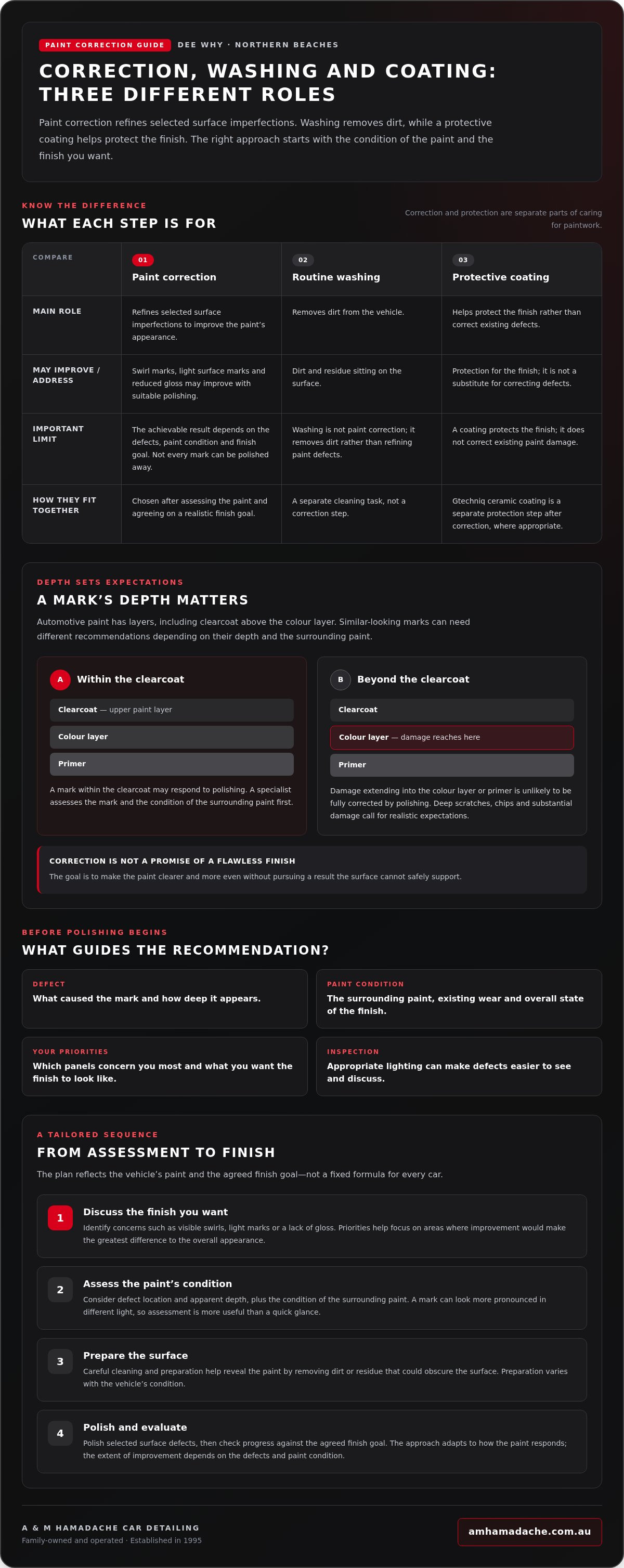
Paint correction is professional polishing intended to improve a vehicle’s appearance by refining selected surface imperfections. The result depends on the paint’s condition and the owner’s finish goals. It differs from routine washing, which removes dirt, and from a protective coating, which helps protect the finish rather than correct existing defects. Understanding the layers of automotive paint, including the clearcoat above the colour layer, helps explain why a careful approach matters.
Which paint imperfections may respond to correction?
Swirl marks are fine circular scratches that can stand out in reflected light, especially on darker or glossy paint. Light surface marks and a loss of gloss may also improve with suitable polishing. The aim is to refine the paint’s appearance, not simply cover defects with a temporary layer of wax.
Suitability depends on what caused a mark, how deep it is, the condition of the surrounding paint and how uniform a finish you want. A mark within the clearcoat may respond to polishing. Damage that extends through the clearcoat into the colour layer or primer is unlikely to be fully corrected this way. Deep scratches, chips and other substantial damage call for realistic expectations, not aggressive polishing. A specialist can explain the likely improvement before work begins.
Why start with the vehicle’s condition?
Similar-looking scratches can call for different recommendations on different vehicles. One may have a light surface mark, while another has deeper damage or paint in a more delicate condition. Existing wear and the overall state of the finish also affect what can be improved. A one-size-fits-all approach can’t set the right goal for every car.
An assessment provides a practical starting point: identify your concerns, examine the paint and agree on a suitable finish goal. Inspection under appropriate lighting makes defects easier to see and discuss. If the paint looks uneven in the sun or shows swirls after washing, note which panels concern you most and what you want the finish to look like. This helps keep the assessment focused on the areas that matter to you.
For local owners, the useful question isn’t whether every mark can disappear. It’s whether tailored correction can make the paint look clearer and more even without pursuing a result the surface can’t safely support. That balance is central to professional paint correction and restoration.
How professional paint correction works, from assessment to finish
Good correction is planned before polishing starts. The aim is to understand the paint, identify the concerns and agree on a realistic finish goal, not to apply the same treatment to every vehicle. If you’re considering expert paint correction Dee Why, knowing the general sequence can clarify what to expect and help set sensible expectations.
- Discuss the finish you want. Start with the issues you’ve noticed, such as visible swirls, light marks or a lack of gloss. Identifying your priorities helps focus on areas where improvement would make the greatest difference to the overall appearance.
- Assess the paint’s condition. The finish is examined before deciding what correction is appropriate. The location and apparent depth of defects, as well as the condition of the surrounding paint, inform the plan. A mark that looks minor from one angle may be more pronounced in different light, so assessment is more useful than a quick glance.
- Prepare the surface. Dirt or residue can obscure the paint and interfere with evaluating the finish. Careful cleaning and preparation help reveal the surface, so the correction plan is based on the paint rather than material sitting on it. The preparation required varies with the vehicle’s condition.
- Polish and evaluate the result. Polishing works on selected surface defects to refine the paint’s appearance. The specialist checks progress against the agreed finish goal and adapts the approach to how the paint responds. The extent of improvement depends on the defects and the paint’s condition.
Inspection and preparation before polishing
Assessment is more than deciding whether a car needs polishing. It helps distinguish between marks that may respond to correction and damage that calls for more cautious expectations. Preparation makes the surface easier to evaluate, and the inspection guides both the work and the finish that can reasonably be pursued. No single approach suits every vehicle.
Polishing, checking and setting expectations
Polishing is targeted refinement, not a promise to erase every imperfection. The finish is considered against the agreed goal as work progresses. If a defect appears too deep to address through polishing alone, preserving a sensible approach matters more than chasing complete removal. This distinction helps owners understand the difference between visible improvement and a flawless finish.
A sound correction plan reflects the paint’s condition and the finish goal, not a fixed formula applied to every car. Professional paint correction should be tailored rather than treated as identical steps for every vehicle. Dee Why and Northern Beaches owners can explore A & M Hamadache’s paint correction and restoration as an option for improving their vehicle’s finish.
Paint correction limits: scratches, clear coat and realistic results
Paint correction can improve suitable defects, but it can’t promise that every mark will disappear. Scratch depth and the condition of the surrounding paint affect what can reasonably be achieved. For owners considering expert paint correction Dee Why, an honest assessment should explain the likely improvement and the limitations before polishing begins.
A vehicle’s colour sits beneath a clearcoat, which forms the visible outer surface of many modern paint finishes. Marks confined to that surface may respond to polishing. If a scratch has gone through the clearcoat into the colour layer or primer, polishing alone won’t restore the missing paint. That damage may need another repair approach, such as touch-up paint or panel respraying. Correction improves appearance; it isn’t a substitute for paint repair.
Can correction remove every scratch?
No. Shallow marks and deeper scratches aren’t the same problem, even if they look similar from a distance. A light surface defect may become less noticeable after suitable correction, while a deep scratch, chip or area of paint damage may remain visible. The vehicle needs to be assessed before deciding what polishing can achieve.
The goal is an appropriate improvement that respects the paint, not perfection at any cost. For example, reducing the visibility of marks across a panel may create a clearer, more even-looking finish, even if one deeper defect remains. A specialist should set expectations around the overall result rather than suggest every imperfection can be removed.
Does machine polishing damage clearcoat?
It’s understandable to be cautious about machine polishing, particularly if you’re concerned about the paint’s long-term condition. Polishing is a corrective process, so it needs to suit the surface being treated. That doesn’t mean all machine polishing is inherently harmful; it means the vehicle’s paint condition and the depth of the defects matter when deciding what work is suitable.
A measured approach starts by examining the finish and setting a realistic goal. If the paint is already compromised or a mark appears too deep, further correction may not be appropriate. The decision should balance visible improvement with care for the existing finish, rather than treating every defect as a target for removal. An assessment helps clarify what makes sense for your car, instead of relying on general advice that may not suit its paint.
Realistic correction aims to improve suitable defects, not guarantee the complete removal of every mark. That distinction helps owners make an informed choice: correction can refine paint’s appearance, while repainting or repair addresses damage that polishing can’t resolve. A & M Hamadache’s professional paint correction and restoration is tailored to the vehicle’s condition and the finish you want, with limitations discussed as part of setting an achievable outcome.
Choosing paint correction in Dee Why: timing, protection and aftercare
There’s no single schedule that makes paint correction necessary. Base the decision on what you can see on the vehicle and how you want the finish to look. If swirl marks, light surface defects or a flat appearance are distracting you, a professional assessment can help establish whether correction is suitable and what improvement is realistic.
When should a Dee Why driver consider correction?
Start with your priorities. You might want the paint to look clearer before an important occasion, or prefer a more even finish in everyday light. Look across the panels and note where marks or reduced gloss are most noticeable. The vehicle’s condition, not its age or whether it’s new or used, should guide the recommendation. Not every car needs correction.
Correction may also be worth considering before applying paint protection. Polishing can improve suitable existing defects, while protection is intended for the finish after that work. The right sequence depends on the paint and your goals. If you’re exploring expert paint correction Dee Why, discussing both aims helps keep correction and protection separate rather than assuming one includes the other.
What should follow a corrected finish?
Once the finish has been refined, protection is a separate choice. Ceramic coating doesn’t perform the same role as paint correction: correction addresses selected defects, while coating is a protective step. A & M Hamadache offers Gtechniq ceramic coating, which may follow correction where appropriate. Read the ceramic paint protection guide to understand the role of protection after paintwork has been corrected.
Aftercare should suit the finish and the products applied. Follow the care guidance provided for your service and use considered washing habits to look after the paint. Coatings and protection products may have different maintenance requirements, so follow the instructions for the particular service.
For a wider view of how correction and restoration fit together, see the paint correction and restoration guide. It can help you consider the process alongside your own finish goals.
To discuss a tailored approach, explore A & M Hamadache’s paint correction service.
A & M Hamadache: expert paint correction for Dee Why and the Northern Beaches
Choosing paint correction is easier when you know what the work can realistically achieve and that the approach will suit your car. A & M Hamadache provides professional paint correction and restoration for Dee Why and Northern Beaches drivers, guided by the vehicle’s condition and your desired finish. The focus is considered improvement, not a one-size-fits-all treatment or a promise that every mark will disappear.
A family-owned approach to vehicle restoration
The Hamadache family established A & M Hamadache in 1995. The business offers professional paint correction and restoration as part of its vehicle care services. Each vehicle has its own surface condition and concerns, so the service is shaped around the paintwork and the result the owner wants.
Careful restoration starts with understanding the finish rather than assuming every car needs the same work. If your paint has lost gloss or shows marks you’d like addressed, a tailored approach focuses on suitable improvements while recognising the limits of the existing surface. This is useful when considering correction before paint protection, since the two services have different purposes.
Discuss your vehicle’s paint correction needs
A useful first step is to describe the vehicle and what you’ve noticed. Is the concern across several panels or concentrated in one area? Do swirl marks stand out in direct sunlight, or does the paint simply look less even than you’d like? Sharing these details and your preferred finish gives the discussion a practical starting point.
You don’t need to decide in advance what level of correction is required. The paint’s condition helps shape a suitable approach, while your finish goal establishes what matters most to you. You can discuss whether your priority is improving the overall appearance, addressing particular marks or preparing the finish for a separate protection step. Clear expectations matter: some defects may improve, while deeper damage can remain beyond what polishing can address.
For Dee Why and Northern Beaches owners seeking expert paint correction Dee Why, A & M Hamadache offers a local path from describing your concerns to discussing professional correction and restoration. Share what you’ve observed and the finish you’re aiming for through enquire about expert paint correction.
Take the next step towards a clearer finish
Before arranging paintwork, consider what you want to notice when you next look at your car. Is your priority a more even appearance across the panels, less visible swirling or a finish that’s ready for a separate protection step? Having a goal in mind can make the first conversation more focused and help shape an approach around your vehicle, rather than an assumed standard treatment.
With expert paint correction Dee Why, the next step is a practical discussion about the marks that concern you and the finish you’d like to achieve. A & M Hamadache’s professional paint correction and restoration service is tailored to the vehicle’s condition, with Gtechniq ceramic coating available as a separate paint-protection option where appropriate. This lets you make an informed choice about appearance and ongoing care.
Share your priorities with A & M Hamadache and enquire about expert paint correction for your vehicle in Dee Why or across the Northern Beaches.
Frequently Asked Questions
Is paint correction suitable for an older car?
Yes, an older car may be suitable if its paint is in a condition that can support the work. Age alone doesn’t determine suitability. A vehicle with a well-kept finish may respond differently from one with worn, peeling or previously repaired paint. If you’re considering expert paint correction Dee Why, mention any known paint repairs and the areas you’re concerned about so the vehicle can be assessed with its history in mind.
Can paint correction improve faded or dull paint?
It can improve dullness when the appearance is linked to suitable surface defects or oxidation, but it can’t restore paint that has failed or lost its coating. A finish that looks flat but remains intact may respond differently from paint that’s peeling or breaking down. The cause matters. An assessment helps distinguish between a finish that may be refined through polishing and damage that needs a repair approach.
Does paint correction last permanently?
No, correction doesn’t prevent new marks or ongoing changes to the paint. It refines the finish at the time of service, but later washing, general use and exposure can affect its appearance. Careful washing habits can help reduce the chance of adding fresh swirl marks. A protective coating is a separate option and doesn’t make the corrected finish permanent or immune to damage.
Should I get paint correction before selling my car?
It may be worth considering if visible swirls or dullness are affecting the presentation and a clearer finish matters to you. Weigh the paint’s condition and your priorities against the work involved. Correction can improve appearance, but it won’t repair deep scratches, chips or paint failure, and it can’t guarantee a particular sale price. An assessment can help you decide whether the likely cosmetic improvement suits your plans.
Can paint correction be done on a car with existing ceramic coating?
It may be possible, but the existing coating needs to be considered as part of the assessment. Polishing can affect the coating in treated areas, so the suitable approach depends on the paint, coating and correction goal. Tell the detailer what protection has been applied, if you know, and when. That context helps clarify whether correction is appropriate and whether a separate protection step should be considered afterwards.
How should I care for my car after paint correction?
Follow the care instructions for the service and any protection applied, as recommendations can differ. For routine washing, use clean wash materials and a gentle method rather than rubbing dry dust or grit across the paint. A coated and uncoated finish may have different care needs, so follow the guidance provided for your vehicle’s finish.


