
A neat-looking patch is not always the right fix for a sagging roof lining. If your car’s fabric is loosening, sagging car headliner repair Northern Beaches starts with understanding the damage, not simply sticking the material back in place. Heat and humidity can break down the foam backing and adhesive, so the fabric may continue to drop after a quick repair.
Whether your lining can be repaired or needs broader restoration depends on the extent of the sag, the condition of the material and your vehicle’s roof design. A sunroof, overhead console or other roof fitting can also affect how the lining is handled. Where the backing has deteriorated, replacing the fabric may be more suitable than trying to reattach it.
This guide explains common signs of a sagging headliner, what a vehicle-specific assessment considers and what details to share when arranging service. A & M Hamadache Car Detailing is a family-owned Northern Beaches business established in 1995, and provides headlining repairs as part of its broader vehicle restoration work.
Key Takeaways
- Loose fabric near a visor, roof edge, light or sunroof signals a lining issue, but the visible sag alone does not show how extensive it is.
- For sagging car headliner repair Northern Beaches, the repair scope depends on the affected area and the condition of the backing.
- Sharing your vehicle’s make and model, where the fabric is sagging and any roof features helps make the repair discussion more specific.
- An assessment considers the lining and nearby fittings before the repair scope is agreed.
- A & M Hamadache provides headlining repairs as part of its vehicle restoration work on the Northern Beaches.
Sagging car headliner repair in the Northern Beaches: what the signs can tell you
A loose patch beside a sun visor, a droop around the cabin light or an edge peeling away above a door can make a car’s interior look worn. These signs do not reveal exactly what is happening behind the fabric. For sagging car headliner repair Northern Beaches, the visible pattern is a useful starting point for assessment, not a diagnosis by itself.
The headliner is the material fitted to the inside of a vehicle’s roof. Its construction and purpose are outlined in this general guide to Car Headliner Material. A sag might appear as a small bubble near a fitting, a loose edge or a broad section hanging across the roof. The visible area does not necessarily show how far the lining has separated underneath.
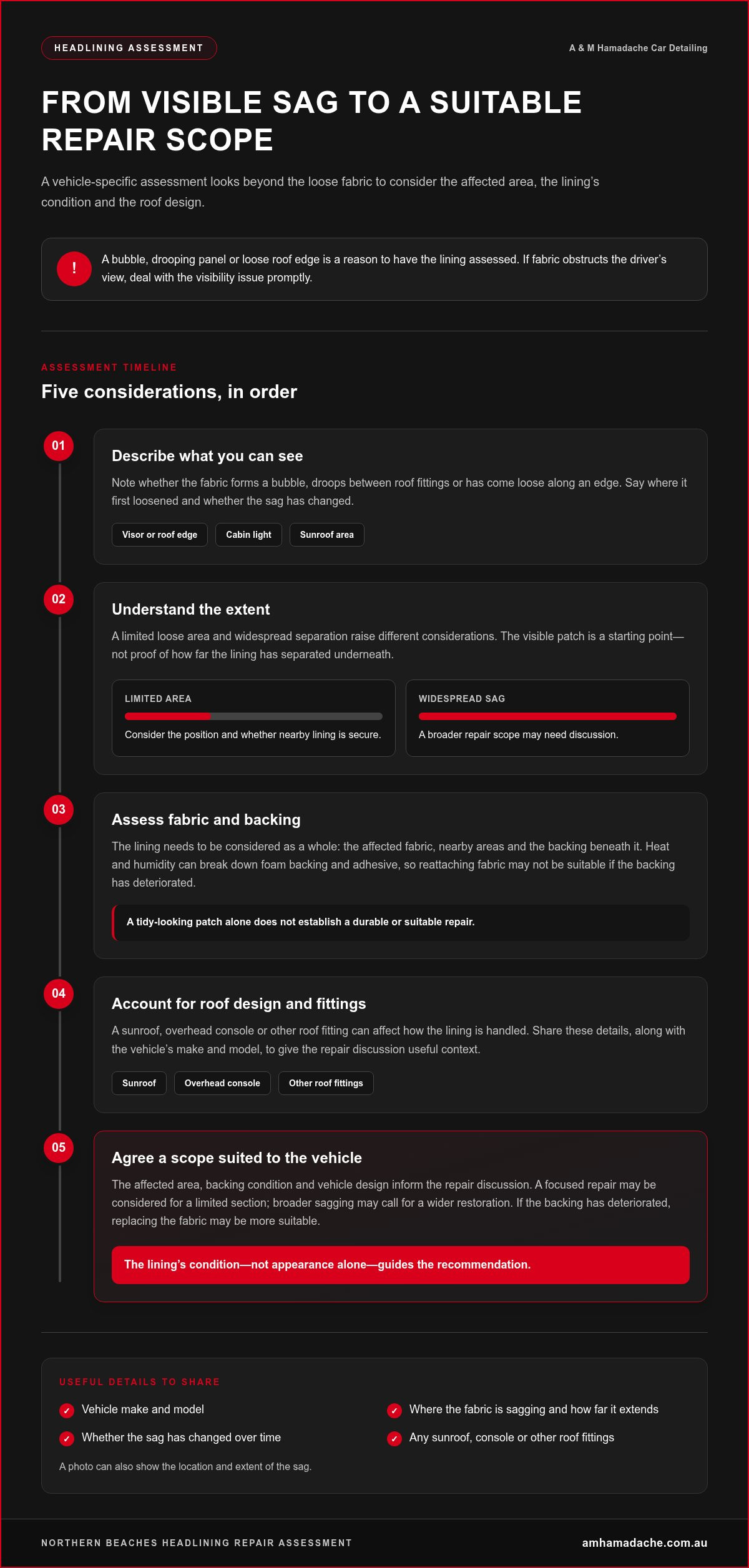
A bubble, drooping panel or loose roof edge is a reason to have the lining assessed. If material obstructs the driver’s view, deal with the visibility issue promptly. Do not wait to see whether the sag worsens if fabric hangs into your line of sight.
Where sagging appears and what to note
Look for bubbles, fabric drooping between roof fittings, loose material along an edge or separation spreading across a wider area. Notice whether the affected patch has stayed in place or changed over time. You do not need to identify the cause. A clear description of what you can see helps make the repair discussion more useful.
- Note where the fabric first loosened and how far the affected area now extends.
- Record whether the sag has changed since you noticed it.
- Mention a sunroof, overhead console or other roof fittings.
These details give the repair team useful context, particularly where fittings or roof openings affect access to the lining. A photo can also show the location and extent of the sag when you arrange an assessment.
Why a visible symptom needs a vehicle-specific assessment
The vehicle’s age and use, the condition of the lining and the extent of the sag all shape the repair discussion. A small loose area and widespread separation may look similar at first glance but raise different considerations. The visible symptom alone cannot establish whether the issue involves the backing, the fabric or another part of the assembly. The lining needs to be assessed in the vehicle.
A particular pattern is not proof of moisture, adhesive failure or material damage. These are possibilities to assess, not conclusions to draw from a photograph or a drooping edge. Describe what you have noticed, including whether the sag has changed, and let the condition of the lining guide the proposed scope. This avoids relying on a one-size-fits-all assumption.
Repair or replacement? How Northern Beaches headlining work is assessed
A sagging headliner does not call for the same fix in every vehicle. The assessment considers how much of the lining is affected and the condition of the backing beneath the fabric. A small loose patch may lead to a different repair discussion from a roof-wide droop. Roof design and fittings can also influence the work involved.
This comparison shows the kinds of observations that may inform the assessment. Appearance alone does not determine the repair:
| What’s observed | What it may mean for the repair discussion |
|---|---|
| Limited loose area | Consider the size and position of the affected section, and whether the surrounding lining is secure. |
| Widespread sagging | Discuss a broader repair scope, particularly if separation extends across several areas. |
| Additional lining concerns | Account for the lining’s condition around roof fittings, a sunroof or other features. |
The key distinction is between what you can see and what the lining’s condition supports. A visible patch is not automatically a durable or suitable repair. The material around it and the backing beneath it matter too. If nearby areas are also loose, addressing only the most noticeable spot may not reflect the wider condition of the lining. A tailored assessment is more useful than assuming every sag can be handled in the same way.
When a focused repair may be considered
The size and position of a loose area help shape the initial assessment. A small section near a fitting differs from separation extending along a roof edge, but appearance alone does not settle the repair scope. The lining needs to be considered as a whole. A patch that looks tidy at first may not be appropriate if nearby material or backing is also compromised.
When broader restoration may be appropriate
If sagging spans a large part of the roof, the repair discussion may need to cover a broader area instead of one visible spot. The observed condition of the lining helps determine the scope. Sunroofs, overhead consoles and other roof fittings can also affect how the work is approached because the lining is integrated with the vehicle’s interior design. The Automotive Interior Design and Materials perspective highlights how interior components contribute to a vehicle’s overall design.
The right recommendation depends on the lining’s condition and the vehicle’s design, not on a one-size-fits-all repair rule. For sagging car headliner repair Northern Beaches, the practical steps are to assess the affected area, consider the backing and fittings, then determine a suitable scope for that vehicle.
Learn more about Northern Beaches headlining repairs from A & M Hamadache Car Detailing.
What happens during professional car headliner repair?
Professional headlining work begins with a discussion about what you have noticed, followed by an assessment of the lining and a conversation about the appropriate scope. Once the work is agreed, the repair is completed and reviewed. The method depends on the vehicle and the lining’s condition, so the process is not identical for every car.
Roof fittings and interior trim need to be considered during the work. Visors, lights, consoles and sunroof surrounds sit close to the headliner, and the vehicle’s layout affects how the lining can be accessed. Considering these nearby components keeps the repair focused on the interior as a whole, rather than treating the fabric as an isolated panel.
A typical sequence includes:
- Discuss the symptoms: describe where the fabric has loosened and whether the area has changed.
- Assess the lining: consider the visible damage, surrounding material and relevant roof features.
- Agree on the scope: clarify which areas the proposed work will address and the intended outcome.
- Complete and review: carry out the agreed work, then review the result and relevant details with you.
This is a general framework, not a fixed method or turnaround time. For sagging car headliner repair Northern Beaches, the vehicle’s design and the lining’s condition guide the work from assessment to completion.
Information that helps assess the job
When arranging an assessment, share the vehicle’s make, model and year, along with where the sagging appears. Say whether it is near a sunroof, visor, light or roof edge, and mention any changes you have noticed. Clear photographs can help show the affected area, but they do not replace an assessment of the lining itself.
Specific descriptions make the initial discussion more useful. For example, “the fabric is loose above the passenger-side visor” gives a clearer starting point than “the roof lining is sagging”. If the affected area has spread, explain how it has changed and roughly when you first noticed it. You do not need to diagnose the cause. Describing the symptom is enough.
How the repair scope is communicated
The proposed work should reflect what is observed on your vehicle, including which areas are affected and how nearby fittings relate to the lining. Be clear about what you would like addressed, such as one loose section or a broader area, and discuss the result you want. This helps align the scope with your priorities before work proceeds.
A repair plan sets out the proposed work and its intended outcome. Clear communication helps keep expectations grounded: you understand what the agreed scope covers, and the work remains tailored to the lining and vehicle design.
Arranging sagging car headliner repair around the Northern Beaches
Preparing a few details before making an enquiry makes it easier to explain what is happening and frame the repair discussion. For sagging car headliner repair Northern Beaches drivers can start by noting the vehicle details, where the fabric has loosened and whether the area has changed. This is useful whether you are contacting a local service from Dee Why, Warriewood or another Northern Beaches suburb.
A clear description does not need technical terms. “The lining is dropping near the rear roof light” gives a more useful starting point than saying the roof looks untidy. Photos add context, while an in-person assessment helps establish the lining’s condition.
A short checklist before making an enquiry
Gather the basics and describe what you can see. This keeps the first conversation focused and gives the repair team a clearer picture of the vehicle and affected area.
- Vehicle details: note the make, model and year.
- Roof features: mention a sunroof, overhead console or other relevant fittings.
- Location of the sag: describe whether it is near a visor, light, roof edge or another area.
- Change over time: say whether the loose fabric has spread or remained in one place.
- Photographs: take one close view of the affected section and another showing the wider roof lining.
Take photos in good light and include enough of the surrounding area to show where the sag sits in the cabin. A close-up alone can hide its position; a wider view provides context. Images help describe the issue, but cannot show every aspect of the lining’s condition.
Set useful expectations for the discussion
The lining’s observed condition shapes the proposed scope, so an initial description or photograph is a starting point rather than a final repair plan. Be clear about the areas you would like addressed and the result you want. If a sunroof, visor, light or trim feature needs particular care, mention it early so it can be considered in the vehicle-specific discussion.
Keep the conversation practical: describe what you have noticed, share the vehicle details, then discuss what the assessment indicates. The repair approach and timing depend on the vehicle and the work involved. Discuss the proposed scope and timing before proceeding so you understand the arrangements.
A & M Hamadache Car Detailing provides headlining repairs as part of its vehicle restoration work. Discuss your headlining repair enquiry with the Northern Beaches team.
A & M Hamadache headlining repairs: your next step
A loose or drooping roof lining can make an otherwise well-kept vehicle feel tired. Deciding what to do starts with describing the symptom clearly and assessing the particular vehicle. A & M Hamadache Car Detailing provides headlining repairs as part of its broader vehicle restoration work, with the repair scope guided by the lining’s condition rather than a single assumed fix.
A considered approach to interior restoration
Family-owned and operated, A & M Hamadache has been established on the Northern Beaches since 1995. Its headlining repairs sit alongside trim repair and other restoration work, bringing the cabin’s appearance and condition into the wider picture of vehicle care. The assessment remains specific to the vehicle in front of the team.
Each vehicle has its own roof layout, fittings and signs of wear. The affected area, extent of the sag and features such as a sunroof all help inform the repair discussion. Rather than assume one process suits every lining, the aim is to understand what you have noticed and determine a suitable scope for that vehicle. This keeps the conversation grounded in the observed condition and the result you want for the interior.
For owners considering sagging car headliner repair Northern Beaches, describing the visible issue clearly and discussing the repair scope can make the decision more straightforward. You do not need to know the technical cause. Saying where the lining is loose and how far the affected area extends gives the discussion a useful starting point.
Take the next step with your vehicle details ready
Before making an enquiry, note the vehicle’s make, model and year, then describe where the fabric is sagging and whether the affected area appears localised or widespread. Mention relevant roof features, including a sunroof, visor, light or overhead fitting. Clear photographs can show the location and scale of the issue, while an assessment provides a fuller view for discussing the work.
It also helps to say what you would like the repair to address. You might be concerned about a loose edge, a section that has continued to drop or the overall appearance of the cabin. Sharing that priority allows the conversation to cover the affected areas and intended result, with the final scope guided by the lining’s condition and vehicle configuration.
For a considered discussion about your vehicle’s interior, explore A & M Hamadache's headlining repair service.
Give your vehicle’s interior a considered next step
A sagging roof lining can be easy to put off, particularly if it seems like a small cosmetic issue. A clear repair discussion helps you decide what makes sense for your vehicle instead of relying on a temporary patch or guessing at the cause. The aim is a tidy cabin and a repair scope that reflects the lining’s condition.
For sagging car headliner repair Northern Beaches, start with what you have observed and let a vehicle-specific assessment guide the next decision. Headlining work is part of A & M Hamadache’s broader vehicle restoration services, alongside trim repair. The repair discussion can consider the interior as a whole, with the focus on your vehicle and the result you want.
Ready to discuss your vehicle’s lining? Contact A & M Hamadache about headlining repairs.
Frequently Asked Questions
Can I glue a sagging car headliner back up myself?
You can attempt a DIY fix, but glue applied through the fabric may leave marks, hard patches or uneven areas, and may not hold if the backing has deteriorated. A small droop can also conceal a wider problem. Avoid pins or household adhesives, which can damage the lining or create an untidy result. For sagging car headliner repair Northern Beaches, an assessment helps establish whether a lasting repair is practical.
Is a sagging car headliner a safety issue?
It can become a safety concern if loose material hangs into the driver’s view or interferes with visibility through a window. A lining that is only slightly loose and clear of the driver’s sightline may be less urgent, but keep an eye on any movement. If fabric drops far enough to obstruct your view, do not drive until you can see clearly and arrange prompt attention to the lining.
Can a car roof lining be repaired without replacing the whole headliner?
Sometimes, but it depends on how localised the damage is and whether the underlying backing can still support a repair. A small affected area with sound surrounding material may be assessed differently from fabric that has separated across the roof. Because the foam backing often deteriorates along with the adhesive, simply reattaching old fabric may not last. The appropriate scope is best determined from the lining’s condition.
How long does professional car headliner repair take?
There is no single reliable timeframe for every vehicle. The work can vary with the size of the lining, how it is fitted and whether a sunroof, console or other roof feature needs attention. These details can affect access and the repair process. Share your vehicle’s make and model when arranging an assessment, then discuss timing alongside the proposed scope rather than relying on a general estimate.
Can a sagging sunroof headliner be repaired?
Yes, a vehicle with a sunroof can have its headlining assessed for repair. The sunroof opening and surrounding trim form part of the roof layout, so they can affect how the lining is handled and what work is involved. Note whether the sag is beside the opening, along its edge or elsewhere in the cabin. That distinction helps explain the issue, while an assessment guides the repair approach.
What causes a car headliner to sag?
Heat and humidity can gradually weaken the foam backing and the adhesive that holds the fabric in place. As the bond deteriorates, fabric may begin to bubble, loosen at an edge or droop across a larger section. Age and vehicle use can also be relevant, but the appearance alone does not confirm the cause. An assessment helps distinguish what is visible from what is happening beneath the fabric.


