
The lowest quote for dash cam installation Sydney may not be the best fit for your vehicle. Options range from product retailers to task marketplaces and local automotive services. To compare them, find out how the camera will be powered, where it will sit and how the cables will be routed.
It’s reasonable to ask about hardwiring, parking mode and hidden cables. A neat installation should also take account of the vehicle’s trim, airbags and existing safety systems. The right approach depends on your camera, your vehicle and whether you want the camera to record while parked.
This guide explains how to compare camera and power options, what to ask about the installation method, and which vehicle details to share before requesting a quote. You’ll also find questions to ask before booking and a handover checklist for checking camera position, recording and power. A & M Hamadache Car Detailing is a family-owned Northern Beaches automotive business with audiovisual installation among its services. Dash-cam installation isn’t specifically confirmed, so check availability and vehicle compatibility before making arrangements.
Key Takeaways
- Understand what fitting and configuring a dash cam involves, and how it differs from buying a camera or installing it yourself.
- Use your vehicle’s make, model, year and factory-fitted technology to help check camera compatibility, power options and placement.
- Compare installers by their scope, vehicle experience, equipment arrangements and post-installation checks, not price alone.
- Before booking, confirm what’s included, share your vehicle details and check the camera’s operation during handover.
- For dash cam installation Sydney enquiries, A & M Hamadache Car Detailing’s audiovisual installation service may be relevant. Confirm dash-cam availability, vehicle compatibility and the exact scope directly.
Dash Cam Installation Sydney: What the Service Should Cover
Buying a camera and fitting it are separate steps. A dash cam installation Sydney service typically involves mounting and positioning a camera in a particular vehicle, connecting its power and, where agreed, configuring requested features. The exact work depends on the camera, vehicle layout and functions you want.
At a glance: A fitted dash cam is mounted in a chosen position, connected to power and checked for basic operation. A dashboard-mounted camera may record, but its mounting, cable routing and power setup aren’t necessarily tailored to your vehicle.
A dashboard camera can be a front-facing unit or part of a system with additional cameras and features. Before booking, establish whether you’re buying equipment only, fitting it yourself or asking a professional to handle the installation. Check the quoted scope rather than assuming the camera, accessories, setup and fitting are all included.
What can a professionally fitted dash cam include?
Depending on the equipment and vehicle, the work may include mounting the camera, connecting its power and checking that it starts and records. A front-only setup differs from fitting a rear camera, while parking-mode recording may need compatible equipment and a suitable power connection. Ask which functions are included, what accessories are needed and whether the camera’s operation will be checked at handover.
A & M Hamadache Car Detailing lists audiovisual installation among its services, but dash-cam fitting and specific inclusions aren’t confirmed. Before booking, check availability, vehicle compatibility, whether customer-supplied equipment is accepted, and whether hardwiring, parking-mode setup and post-installation checks are available.
When does professional installation make sense?
A professional may be a useful option if you’d rather not remove trim or route cables yourself, or you want a tidier finish. Some vehicles have complex trim, limited mounting positions or factory-fitted technology that can affect the installation approach. That doesn’t mean every car needs the same work or that DIY is unsuitable for everyone. Choose the approach that matches your confidence and the camera’s requirements.
Before agreeing to a job, describe your vehicle and the result you want. Ask how the cables will be routed, whether any trim needs to be removed and what checks will be performed. Clear answers make it easier to compare providers on the work involved, not just on the promise of a quick fit.
Dash Cam Fitment in Sydney: Check Compatibility, Power and Placement
A good fit starts with the vehicle, not just the camera. Before asking about dash cam installation Sydney, note your vehicle’s make, model and year, along with any factory-fitted windscreen sensors, driver-assistance cameras or other equipment near the rear-view mirror. These details help an installer assess possible camera positions and cable and power routes.
Vehicle compatibility affects your camera choice, power setup and installation approach.
Camera features matter too. A front-only unit has different requirements from a system with a rear camera, while parking mode may need a camera and power arrangement designed for that function. CHOICE offers practical advice on how to buy the best dashboard camera. Check the specifications of your chosen camera before arranging a fit.
Which power option suits your dash cam use?
A standard power-outlet connection uses the vehicle’s accessory socket and is often a straightforward option. Whether it switches off with the ignition depends on the vehicle, so check how it behaves rather than assuming it works the same way in every car. A hardwired connection links the camera to the vehicle’s electrical supply, commonly through a fuse connection. Its suitability should be assessed for the specific vehicle and camera.
Some drivers want recording while parked. This may require constant power, meaning power remains available when the ignition is off, as well as a compatible camera and suitable setup. Check the manufacturer’s instructions for any battery-protection function. Don’t assume the camera or wiring will prevent battery drain. Ask whether the proposed connection supports your intended use and what the setup includes.
Where should a dash cam be positioned?
The camera needs a useful view of the road without obstructing the driver’s clear view. NSW guidance recommends mounting it high on the windscreen, behind or beside the rear-view mirror, where practical. Check current requirements with an authoritative NSW road-safety source before fitting, especially if your vehicle has a restricted windscreen area or equipment clustered around the mirror.
Ask the installer to consider existing sensors, cameras and other windscreen technology before choosing a position. A location that works in one vehicle may interfere with equipment or visibility in another. Check that the lens has a clear view and that the unit doesn’t distract you or block your sightline from the driver’s seat.
A & M Hamadache lists audiovisual installation among its services, but dash-cam availability and fitment details need to be confirmed directly. You can enquire about audiovisual installation and ask whether your vehicle, camera and preferred power setup can be accommodated.
Compare Dash Cam Installation Options in Sydney Before You Book
There’s more than one way to arrange a dash-cam fit. An automotive specialist may assess the vehicle and installation requirements; a task marketplace connects you with individual providers; and a product retailer may sell cameras and offer fitting. The service model alone doesn’t tell you who will do the work or what’s included. For dash cam installation Sydney, compare the proposed scope and vehicle suitability before deciding.
- Automotive specialist: Request a written description of the work. Check experience with your vehicle and camera type, and confirm whether you or the business supplies the equipment. Ask which operation checks and follow-up are included.
- Task marketplace: Set out the exact job, then confirm the details directly with the selected provider. Ask about relevant vehicle experience, who sources the camera and accessories, and who to contact if an issue arises after fitting.
- Product retailer with fitting: Check whether fitting is available and what it covers. Confirm that the service suits your vehicle, whether the camera is supplied with the purchase or separately, and whether testing and follow-up are included.
Questions to ask a dash cam installer
Before booking, ask who will carry out the installation and whether they’ve worked with your vehicle’s make and model and your type of camera. Confirm whether camera supply, hardwiring and rear-camera fitting are included or quoted separately. If sensors, trim or other factory-fitted features could affect cable routing, ask how the installer will assess the route and what happens if the proposed approach needs to change.
How to assess the quote and service scope
Request an itemised description before agreeing to proceed. It should explain what equipment and labour are covered, which power method is proposed, whether a rear camera or parking-mode setup is included, and what checks will be completed. Ask who to contact if the camera doesn’t operate as expected after the work.
Compare like with like. A lower quote may cover a different scope, so weigh clarity, vehicle suitability and agreed checks alongside the price. If you’re also considering other in-car equipment, an audiovisual installation guide can provide broader context when available. Keep your vehicle details and camera requirements to hand when requesting a quote, then confirm each part of the arrangement with the person responsible for the work.
Prepare for Dash Cam Installation in Sydney and Check the Finished Fit
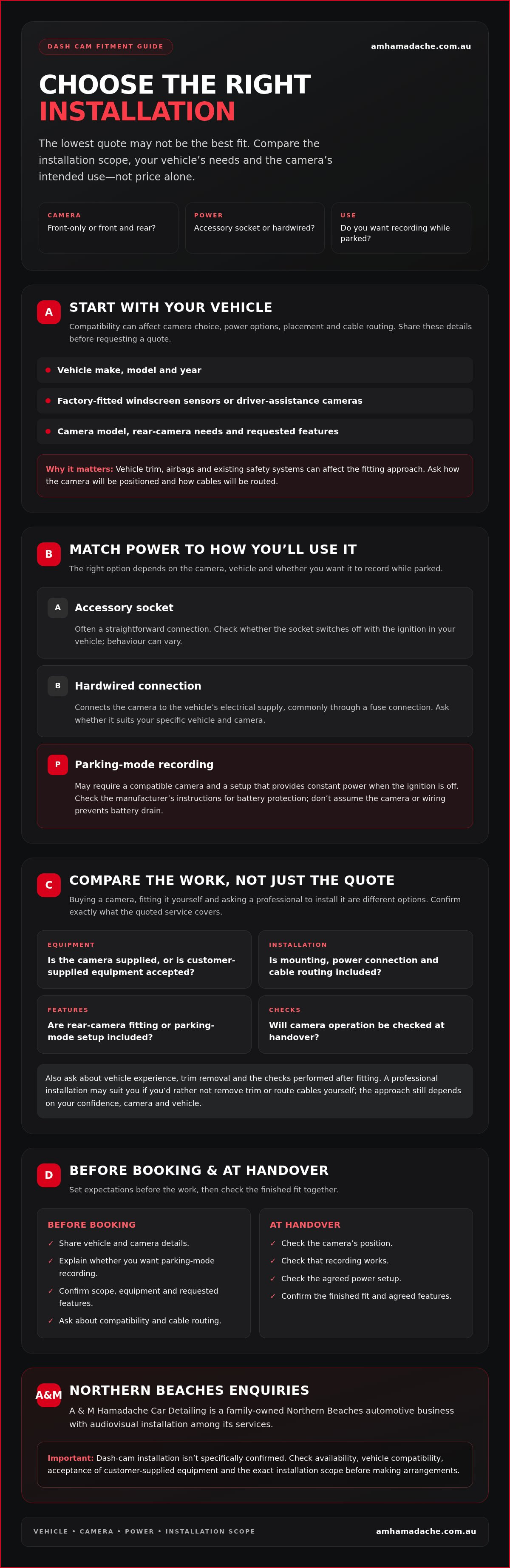
A few checks before your appointment can prevent confusion about equipment, access and the agreed work. For dash cam installation Sydney, confirm the scope first, share your vehicle and camera details, prepare as requested, then review the finished fit with the installer.
What to confirm before the appointment
Send the vehicle’s make, model and year, along with the camera type and whether you want front-only recording, a rear camera or parking mode. Before confirming the booking, agree on what will be fitted, the power connection, any equipment you need to supply and which checks are included. Ask how timing and vehicle access are arranged, as these details depend on the business’s current process.
If the installer confirms they accept customer-supplied equipment, ask whether to bring the camera, its accessories and a compatible memory card. Check whether they need the vehicle keys and whether anything should be cleared from the cabin. Don’t assume equipment or accessories are included unless that’s been confirmed.
What to check at handover
Review the installation with the person who carried out the work. Check that the camera feels secure, is aimed at the road and doesn’t obstruct your view. Ask for a demonstration of recording and an explanation of the basic controls, including how to check or retrieve footage. If a rear camera was part of the agreed job, confirm that its view is working as expected.
Test the power behaviour you agreed on. If parking mode was included, ask the installer to show how it’s set up and explain how the vehicle-specific power connection behaves when the ignition is off. Don’t assume parking mode or battery protection is active just because the camera has that capability. Check the camera settings and what was actually configured.
- Before: Confirm the job, equipment, vehicle details, timing and access arrangements.
- At handover: Check positioning, visibility, recording, power behaviour and any agreed parking-mode function.
- Before leaving: Ask who to contact if a function covered by the agreed scope doesn’t work as demonstrated.
A & M Hamadache is a Northern Beaches automotive business with audiovisual installation listed among its services. Dash-cam availability, customer-supplied equipment and vehicle compatibility need to be confirmed directly. Enquire about audiovisual installation and ask what requirements apply to your vehicle and camera.
Arrange Dash Cam Installation Near Sydney’s Northern Beaches
Looking for dash cam installation Sydney drivers can enquire about locally? A & M Hamadache is a family-owned Northern Beaches automotive business established in 1995. Audiovisual installation and mechanical repairs are among its listed services, but dash-cam installation isn’t specifically confirmed. Contact the business to check whether it’s currently available and what work may suit your vehicle.
A clear enquiry helps establish whether your vehicle and preferred setup are suitable before you make arrangements. Include the details below, then ask for confirmation of the proposed work and any equipment you may need to provide.
What to include in your enquiry
- Vehicle: Provide the make, model and year, and mention any relevant factory-fitted technology around the windscreen.
- Camera setup: Say whether you’re considering a front-only camera or a system with a rear camera.
- Power and features: Explain whether you’re interested in hardwiring or parking-mode capability, so the business can advise whether these requirements can be met.
- Equipment: Ask whether the business can supply a suitable camera or fit equipment you already own. Confirm acceptance before bringing customer-supplied gear.
It’s also useful to ask what the installation would cover, including any agreed setup and checks, and who to contact with a follow-up question. Don’t assume a particular camera, power method or feature is available until it’s been confirmed for your vehicle.
Choose a local automotive team with clear scope
Before booking, make sure you know who will carry out the work, what the arrangement includes and how any changes would be discussed if the proposed fit isn’t suitable. A & M Hamadache’s audiovisual installation listing makes it a local business to ask about your requirements. Its established history provides background, but doesn’t confirm dash-cam-specific experience or availability.
Share your vehicle details and camera requirements, then confirm current service availability, compatibility and scope directly. Enquire about your dash cam installation requirements.
Make Your Next Dash Cam Fit a Considered One
A reliable dash-cam setup starts with your vehicle and how you plan to use the camera. Check compatibility, choose a power option that suits your needs, and confirm that the proposed position keeps your view of the road clear. Before booking, compare what each provider includes, who will do the work and what checks you can expect at handover.
For dash cam installation Sydney enquiries, A & M Hamadache is a family-owned and operated Northern Beaches automotive business established in 1995. Audiovisual installation is listed among its services, but dash-cam installation availability, vehicle compatibility and the exact scope need to be confirmed directly.
Share your vehicle’s make, model and year, along with your camera and feature requirements, to help clarify whether the work may suit your needs. Enquire about your dash cam installation requirements and ask what’s currently available. A clear conversation before booking is a practical first step towards a fit that works for your vehicle.
Frequently Asked Questions
How much does dash cam installation cost in Sydney?
The cost of dash cam installation in Sydney depends on the agreed work, so request an itemised quote for your vehicle and setup. A front-only camera using a power outlet may involve different work from a front-and-rear system or hardwired installation. Ask whether the quote includes fitting, equipment, setup and operation checks, and clarify any additional work before agreeing to proceed. Compare the scope, not just the quoted amount.
Can a dash cam be hardwired into any car?
No. Hardwiring suitability depends on the vehicle’s electrical layout, the camera and the intended use. Provide the installer with your car’s make, model and year, and ask them to assess the proposed connection. If you want parking mode, check that the camera supports it and ask what power arrangement is required. Don’t assume every vehicle or camera supports the same setup, or that battery protection is included.
How long does professional dash cam installation take?
There isn’t one reliable time that applies to every installation. The work can depend on whether you’re fitting a front camera or front-and-rear system, the vehicle’s layout, the chosen power connection and any agreed setup checks. Ask the installer for an estimate after sharing your vehicle details and camera requirements. Confirm how appointment timing and vehicle access are arranged rather than relying on a general timeframe.
Where should a dash cam be mounted in NSW?
Mount it where it records a useful view of the road without obstructing the driver’s clear view. NSW guidance recommends a high windscreen position behind or beside the rear-view mirror, where practical. Ask the installer to consider factory-fitted sensors, cameras and other equipment near that area. Check current NSW guidance for your circumstances, and make sure the final position doesn’t interfere with visibility from the driver’s seat.
Can I bring my own dash cam for installation?
Possibly, but confirm that the installer accepts customer-supplied equipment before booking. Share the camera details and ask whether you should bring its power cable, rear-camera cable, mounting parts and a compatible memory card. Also check whether the selected camera suits your vehicle and requested power setup. A & M Hamadache lists audiovisual installation among its services, but whether it accepts or fits customer-supplied dash cams must be confirmed directly.
What should I check after a dash cam has been installed?
At handover, check that the camera is secure, aimed correctly and doesn’t obstruct your view. Ask the installer to demonstrate recording and explain the basic controls. Confirm that the power behaviour matches what you agreed, including whether it switches off with the ignition. If parking mode was part of the job, ask to see its settings and clarify how the vehicle-specific power arrangement works when the car is parked.
Is professional dash cam installation worth it?
It can be worthwhile if you’d prefer help with mounting, cable routing, power connections or camera setup, especially if your vehicle has a complex interior layout. DIY may suit drivers who are comfortable following the camera’s instructions and managing visible cables. The choice depends on your confidence, vehicle and desired features. If booking a professional, confirm their experience with your vehicle and the exact work and checks included.


