
Can you simply spray adhesive onto a falling roof lining and press it back into place? If you've noticed fabric billowing in your rear-view mirror or orange foam crumbs dusting your clothes whenever the windows are down, reaching for a quick aerosol can or upholstery pins is tempting. However, Sydney's brutal cabin heat chemically breaks down the underlying polyurethane foam into powder, leaving the fabric with nothing solid to grip. When that drooping material threatens to fail your annual pink slip safety check, securing professional headlining replacement Sydney vehicle owners trust is the only permanent solution.
Watching your car's interior deteriorate is deeply frustrating, especially when makeshift DIY attempts leave sticky, irreversible stains across the backing board. This expert guide explains why coastal humidity and radiant heat destroy factory roof lining adhesives, compares mobile patch-ups against dedicated workshop restoration, and details the meticulous re-trimming process step by step. Here is how to restore your vehicle's cabin to a taut, factory-fresh condition without risking trim damage or electrical complications.
Key Takeaways
- Understand why Sydney's harsh solar cycles and coastal humidity break down inner foam padding rather than simply drying out adhesive.
- Discover why temporary fixes like upholstery pins or aerosol spray glues accelerate interior damage, whilst professional headlining replacement Sydney motorists rely on provides an enduring solution.
- Review the exact step-by-step workshop procedure required to strip degraded substrates and re-trim headboards to factory tolerances.
- Learn the key material benchmarks and safety criteria to look for when choosing an interior specialist, from UV-rated fabrics to careful handling of curtain airbags.
- Find out how seasoned craftsmen protect your vehicle's market value by seamlessly pairing headlining restoration with complete cabin trim and sunroof care.
Why Car Roof Linings Sag in Sydney: The Causes of Failing Headliners
A true headlining replacement involves the total renewal of both the interior acoustic foam backing and the cabin textile, rather than simply tacking old fabric back against the ceiling. When a roof lining begins to billow downward, drivers usually assume the factory glue let go. In reality, the fabric rarely loses its initial adhesion. The underlying material itself has turned into a fine, powdery crumb. For vehicle owners seeking an enduring headlining replacement Sydney climate conditions demand, understanding how this composite assembly fails is the first step toward a lasting solution.
The Three-Layer Anatomy of an Automotive Roof Lining
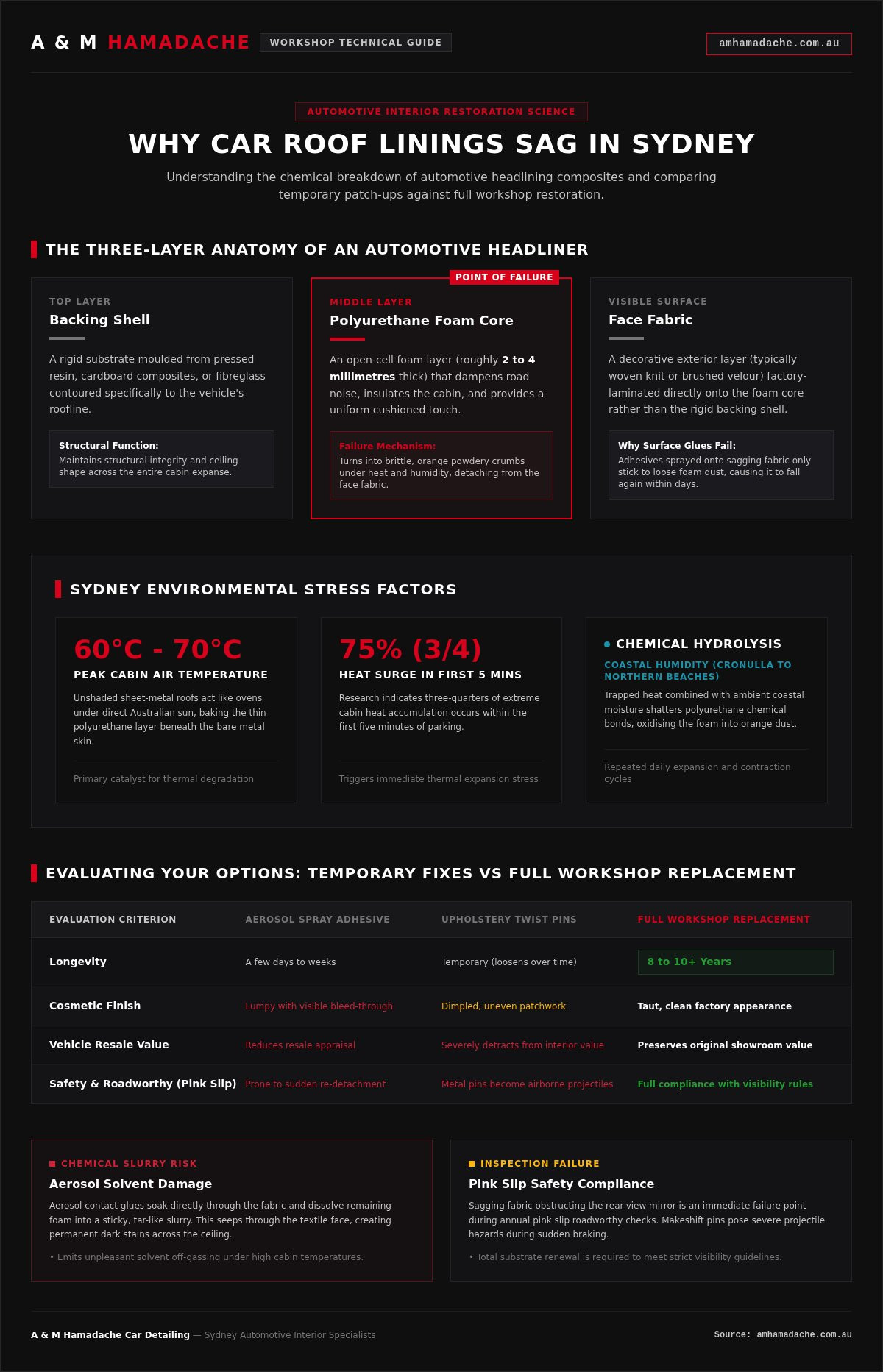
Standard automotive headliner construction relies on a bonded three-part sandwich design:
- The Backing Shell: A rigid substrate moulded from pressed resin, cardboard composites, or fibreglass contoured to your vehicle's specific roofline.
- The Polyurethane Foam Core: An open-cell foam layer (roughly two to four millimetres thick) that dampens road noise, insulates the cabin, and provides a uniform, cushioned touch.
- The Face Fabric: A decorative exterior surface layer, typically woven knit or brushed velour, factory-laminated directly to the foam.
Because the textile bonds directly to the foam rather than the rigid board, applying aerosol glue to a sagging area fails immediately. The adhesive attaches only to crumbling foam dust, dropping down again within days.
Sydney Environmental Factors: Solar Heat and Coastal Moisture
Sydney's climate creates a punishing environment for vehicle interiors. Parked outside in direct sun, an unshaded vehicle's sheet-metal roof acts like an oven. Cabin air temperatures routinely surge between 60°C and 70°C, with research showing three-quarters of that heat spike occurs within the first five minutes of parking. This extreme thermal load bakes the thin polyurethane layer directly beneath the bare metal skin.
Along coastal stretches from Cronulla to the Northern Beaches, elevated humidity introduces moisture into the equation. This combination of trapped heat and ambient moisture triggers chemical hydrolysis, a breakdown where the polyurethane bonds shatter and oxidise into brittle, orange dust. Repeated daily expansion and contraction cycles break down any surviving cohesion, causing the fabric to detach and drape into the cabin.
Temporary Fixes vs Full Headlining Replacement: Evaluating Your Options
Facing a drooping ceiling, many motorists look for quick interventions to stop fabric falling onto their heads. The temptation to reach for a cannister of aerosol spray or a pack of upholstery twist pins is understandable, but these stop-gap measures rarely survive Australian conditions. Assessing these workarounds against a permanent, workshop-grade headlining replacement Sydney specialists execute highlights stark differences across finish, durability, and passenger safety.
| Criterion | Aerosol Spray Adhesive | Upholstery Twist Pins | Full Workshop Replacement |
|---|---|---|---|
| Longevity | A few days to weeks | Temporary (loosens over time) | 8 to 10+ years |
| Cosmetic Finish | Lumpy with visible bleed-through | Dimpled, uneven patchwork | Taut, clean factory appearance |
| Vehicle Value | Reduces resale appraisal | Severely detracts from interior value | Preserves original showroom value |
| Safety / Roadworthy | Prone to sudden re-detachment | Metal pins become airborne projectiles | Full compliance with visibility rules |
Why Adhesive Sprays and Twist Pins Do Not Last
Aerosol contact glues sprayed through the cloth face soak directly into the degraded substrate. Rather than creating a bond, the solvent dissolves remaining foam remnants into a sticky, tar-like slurry that seeps through the textile face, leaving permanent dark stains across your ceiling. Under intense parked heat, these store-bought glues also off-gas unpleasant solvent fumes inside an enclosed cabin.
Twist pins present a different hazard. Puncturing the fibreglass backing shell degrades underlying sound dampening and creates irreversible holes. Driving at speed with open windows creates turbulent cabin pressure that pulls fabric against the pinheads. Pins eventually wiggle free, falling into seat cushions or turning into hazardous flying metal fragments.
The Structural Superiority of a Complete Board Re-Trim
A lasting restoration requires taking the headboard entirely out of the vehicle cabin. Working on an open workbench allows a craftsman to mechanically wire-brush every trace of decomposed foam away, restoring the rigid substrate back to bare board. Technicians then apply industrial, high-temperature contact adhesives rated to withstand sustained radiant heat above 100°C before pressing down fresh, composite foam-backed textile.
This methodical trade process guarantees a crisp, factory finish that won't separate when summer hits. If you prefer dealing with experienced craftsmen who handle interior shells and delicate clips with care, arranging dedicated headlining repairs ensures the job is completed correctly the first time.
What Does a Professional Headlining Replacement in Sydney Involve?
Delivering a genuine factory-grade finish requires patient craftsmanship and systematic disassembly. A standard workshop-based headlining replacement Sydney specialists carry out takes between two and four hours, transforming a neglected ceiling through a rigorous, multi-stage trade procedure.
- Cabin component removal: Stripping all peripheral roof fittings.
- Substrate extraction: Easing the delicate backing shell out of the cabin.
- Mechanical board preparation: Removing degraded foam down to bare composite.
- Adhesive bonding and re-trimming: Applying high-temp adhesive and fresh textile.
- Reassembly and electronic testing: Reinstalling trim, lighting, and safety systems.
Careful Cabin Disassembly and Board Extraction
The process starts inside the vehicle cabin. Technicians remove sun visors, overhead consoles, map lights, grab handles, and coat hooks. Next comes releasing the A, B, and C-pillar garnishes. Modern vehicles house side-curtain airbags and sensitive wiring looms directly behind these plastic pillar covers. Specialists use nylon trim tools to release brittle factory clips without snapping retaining tabs or pinching safety wiring.
Once freed from retaining hardware, the fragile backing board must be extracted. Technicians recline the front passenger seats and gently manoeuvre the large moulded shell out through a rear door or tailgate. Rushing this stage risks bending or cracking the compressed fibreglass board, which permanently creases the finished ceiling line.
Substrate Stripping, Adhesive Application, and Re-Trimming
On an open workbench, technicians mechanically strip every particle of degraded orange foam using specialised wire brushes and solvent wipes. If even a small patch of powdery rot remains, the new material will lift. Once the composite board is thoroughly dry and bare, technicians apply a commercial-grade contact adhesive rated to endure cabin temperatures well above 100°C.
After allowing the adhesive to achieve its optimal flash-off tackiness, new foam-backed automotive fabric is smoothly laminated into place. The trimmer works progressively from the centre outward. This deliberate smoothing prevents air pockets, ensures uniform tension, and maintains crisp lines around sunglasses compartments and grab-handle recesses.
Sunroof Integration, Reinstallation, and Interior Reassembly
For models equipped with sunroofs, the sliding sunshade cassette requires separate re-trimming. Trimmers carefully gauge fabric thickness to ensure the cassette glides freely along its tracks without binding or straining motor mechanisms. Overhead drain tubes are also inspected to confirm they remain securely fastened.
Finally, the renewed assembly is manoeuvred back into the vehicle. Technicians secure internal wiring harnesses, connect antenna leads, plug in dome lighting modules, and clip all pillars back into position before conducting a comprehensive final contour inspection.
Key Factors When Choosing a Headlining Specialist in Sydney
Selecting the right motor trimmer requires looking beyond the cheapest online quote. Entrusting your vehicle to a workshop demands confidence in their craftsmanship, workspace controls, and technical knowledge of modern interior assemblies. To ensure a professional headlining replacement Sydney drivers can rely on for years, use an objective set of criteria to evaluate prospective specialists.
Material Quality and Adhesive Thermal Ratings
Always enquire about the grade of fabric and adhesive being fitted. Automotive fabrics feature a dedicated UV-stabilised knit weave laminated to a density-controlled polyurethane foam core, protecting against accelerated sun fade. Domestic upholstery fabrics lack this resilience, stretching unevenly across compound curves.
Adhesive specifications matter just as much. Demand confirmation that the specialist uses high-solids contact adhesives rated for sustained heat exposure. In Sydney's summer sun, inferior general-purpose adhesives soften, allowing newly trimmed fabrics to sag within months. Quality workshops offer extensive textile swatches, ensuring a precise colour match across factory grey, beige, charcoal, and black interior palettes.
Workshop Craftsmanship vs Mobile Driveway Repairs
While mobile vans offer convenience, re-trimming a roof board outdoors introduces severe quality risks:
- Contamination: Sydney coastal gusts blow salt crystals, road grime, and leaf litter directly onto exposed adhesive layers during the open tack window.
- Curing Interference: Uncontrolled humidity spikes alter flash-off times, leading to uneven bonding and bubbling.
- Substrate Support: Dedicated workshop tables provide uniform, flat surfaces for wire-brushing without stressing or cracking brittle fibreglass contours.
- Secure Storage: Workshop facilities protect unbolted visors, dome lenses, and pillar covers from outdoor gravel or driveway accidents.
Safety Regulations: Airbags, Sensors, and Pink Slip Checks
Modern cabin architecture places delicate systems right beside the roof perimeter. Side-curtain airbags run along the roof rails, whilst rain sensors, hands-free microphones, and lane-assist cameras route cabling directly through the overhead console. Working around these components requires seasoned tradespeople who understand wiring loom disconnections and will not compromise deployment pathways.
Remember that roof lining condition directly affects vehicle roadworthiness in NSW. Under Transport for NSW Light Vehicle Safety Check rules, any fabric drooping into your rear-view mirror sightline constitutes an immediate pink slip inspection failure. For guaranteed peace of mind and meticulous interior care, contact our trim repair and sunroof repairs team to book a professional assessment.
Restoring Your Vehicle Interior with A & M Hamadache Car Detailing
Restoring a sagging roof lining is more than an aesthetic fix; it preserves the structural comfort and market value of your vehicle. Rather than treating fabric re-trimming as an isolated repair, viewing it as comprehensive interior care ensures every trim clip, fabric contour, and pillar finish aligns seamlessly. For motorists requiring dependable headlining replacement Sydney climate conditions necessitate, working with established automotive craftsmen brings lasting confidence.
Over Thirty Years of Proven Automotive Care in Sydney
A & M Hamadache Car Detailing has delivered tailored vehicle preservation since establishing operations on the Northern Beaches in 1995. As an independent, family-owned business, we rely on quiet confidence, technical discipline, and genuine accountability rather than hurried work. Every vehicle entrusted to our workshop receives the same high-level diligence, whether it is a beloved weekend classic, a precision-engineered European tourer, or an everyday family transport.
Decades of hands-on experience handling delicate interior mouldings, complex wiring channels, and fragile headboards ensure that every reassembly step respects your car's original cabin integrity. You deal directly with tradespeople who take pride in lasting results.
Complete Interior Rejuvenation: Beyond the Roof Lining
When the roof lining begins shedding degraded foam, those orange particles embed deep into fabric seating, carpets, and air vents. Resolving the problem properly involves treating the surrounding cabin as well as renewing the ceiling board:
- Companion Trim Work: Replacing separated fabric on door card inserts and addressing sticky or squeaking sunroof cassettes alongside overhead linings.
- Deep Cabin Decontamination: Pairing headlining restoration with our Full Detail Package to extract loose, caustic foam particles from upholstery, footwells, and floor runners.
- Integrated Preservation: Accessing complete paint correction and restoration, rustproofing, and mechanical repairs within our specialised facility.
If your vehicle's ceiling has dropped or interior trims are lifting, visit our workshop for practical, transparent advice. Enquire about headlining repairs with A & M Hamadache today to discuss tailored restoration options that bring your cabin back to a taut, factory-fresh standard.
Bring Back Your Car's Factory-Fresh Cabin
Tackling a sagging ceiling isn't about quick aerosol sprays or unsightly twist pins that trigger pink slip inspection failures and degrade your cabin. A lasting repair demands stripping away hydrolysed foam dust and bonding fresh, UV-stable fabric to an extracted backing board using high-temperature contact adhesive. Investing in a professional headlining replacement Sydney motorists trust ensures your vehicle looks clean, taut, and authentic to its factory design.
Operating on the Northern Beaches since 1995, A & M Hamadache Car Detailing is an independent, family-owned specialist committed to exacting craftsmanship. Our dedicated workshop facilities house comprehensive capabilities under one roof, spanning interior trim repairs and sunroof care through to complete cabin detailing. You get personalised advice from tradespeople who treat your pride and joy with genuine respect.
Don't let drooping fabric or falling foam ruin your daily driving experience. Restore your vehicle's interior with A & M Hamadache Car Detailing and rediscover the quiet comfort of a showroom-quality finish.
Frequently Asked Questions
How long does a professional headlining replacement take in Sydney?
A standard headlining replacement typically takes between two and four hours to complete. This timeframe allows technicians to safely unclip cabin trim, extract the headboard, wire-brush away decomposed foam, spray high-temperature adhesive, and lay fresh fabric. Complex vehicles with panoramic sunroofs, integrated electronics, or fragile vintage pillar mouldings require extra bench time for precise re-trimming and electrical checks.
Can you simply glue back the existing fabric without replacing it?
No, attempting to reglue original fabric never provides an enduring fix. The failure occurs because the underlying polyurethane foam core has disintegrated into a fine crumb, not because the glue lost its tack. Spraying aerosol adhesive onto old fabric bonds only to powdery residue, which separates within days. Genuine headlining replacement Sydney specialists perform requires scraping the board completely clean and applying fresh, foam-backed textile.
Will a sagging car headliner fail a NSW pink slip safety inspection?
Yes, a sagging roof lining is an official rejection item under Transport for NSW Light Vehicle Safety Check standards. Inspectors will fail any vehicle where drooping fabric drops near the driver's head or obstructs rear-view mirror sightlines. If your vehicle receives a pink slip failure notice, NSW regulations give you 14 days to complete repairs and return to the same inspection station for a free reassessment.
Why do European cars seem more prone to sagging roof linings?
European prestige vehicles commonly use biodegradable, water-based contact adhesives and open-cell foam backings formulated for temperate European climates. When exposed to Sydney's punishing solar cycles and coastal humidity, these materials break down rapidly through chemical hydrolysis. Models from Volkswagen, Audi, BMW, and Mercedes-Benz frequently suffer foam dry-rot within five to eight years if parked outside, making full workshop replacement necessary.
What is the difference between workshop headlining repairs and mobile driveway services?
Workshop repairs take place within an enclosed, climate-controlled space that shields wet adhesives from airborne dirt, rain, and coastal winds. Dedicated workbenches allow technicians to mechanically strip substrates flat and clamp compound curves without damaging brittle fibreglass boards. Mobile driveway repairs operate in variable weather, where outdoor humidity and windblown dust can compromise glue tackiness or soil fresh cabin upholstery.
Can you repair sagging headlining if my vehicle has a sunroof?
Yes, vehicles with sunroofs can be fully restored, though they require specialised care. Trimming a sunroof model involves carefully dropping the main ceiling board around the sunroof cassette, clearing internal drainage tubes, and separately re-trimming the sliding sunshade. Technicians must select correct fabric thicknesses so the retractable panel glides smoothly along its tracks without binding, jamming, or straining internal drive cables.
How do high-temperature automotive adhesives prevent headliners from sagging again?
Purpose-built automotive contact adhesives feature specialised polymer bonds formulated to withstand sustained radiant heat above 100°C. Standard domestic glues soften and liquify once summer metal roofs heat vehicle cabins beyond 60°C. High-solids industrial adhesives maintain high tensile strength through repeated thermal expansion and contraction cycles, ensuring a headlining replacement Sydney motorists invest in remains taut and secure for a decade or more.


