
Black paint does not scratch more easily than any other finish; its intense optical contrast simply refuses to hide the truth. If you have ever stepped back after a thorough clean only to see fresh spiderwebs under direct sunlight, you understand the frustration. Master craftsman standards dictate that learning how to remove swirl marks from black car panels safely, without risking delicate factory clear coat or relying on temporary fillers that wash away in the rain, requires a methodical approach.
It is exhausting when every routine wash seems to introduce more circular marring, leaving your dark panels looking hazy rather than sharp. You don't have to accept compromised paintwork or fear the polishing process. You will discover how to properly diagnose defect depth, select the correct dual-action machine, pad, and compound combinations for finicky dark clear coats, and permanently eliminate micro-marring to restore a genuine, mirror-like depth.
Here is your comprehensive, step-by-step walkthrough to achieving a flawless finish, complete with the preventative washing methods required to protect your investment for the long term.
Key Takeaways
- Understand why dark automotive paint exaggerates microscopic scratches and how true clear coat levelling permanently rectifies surface defects rather than temporarily masking them.
- Discover the essential multi-stage decontamination process and why modern dual-action polishers safeguard soft factory clear coats against heat damage.
- Learn the methodical test spot routine and sectional pass patterns that show you how to remove swirl marks from black car panels with surgical precision.
- Differentiate between the temporary cosmetic fillers found in hand glazes and the permanent defect elimination achieved through dedicated machine correction.
- Establish a safe, swirl-free maintenance routine and understand how professional ceramic protection shields your refined gloss against harsh Australian UV degradation.
Understanding Swirl Marks on Black Clear Coat: Why Dark Paint Demands Precision
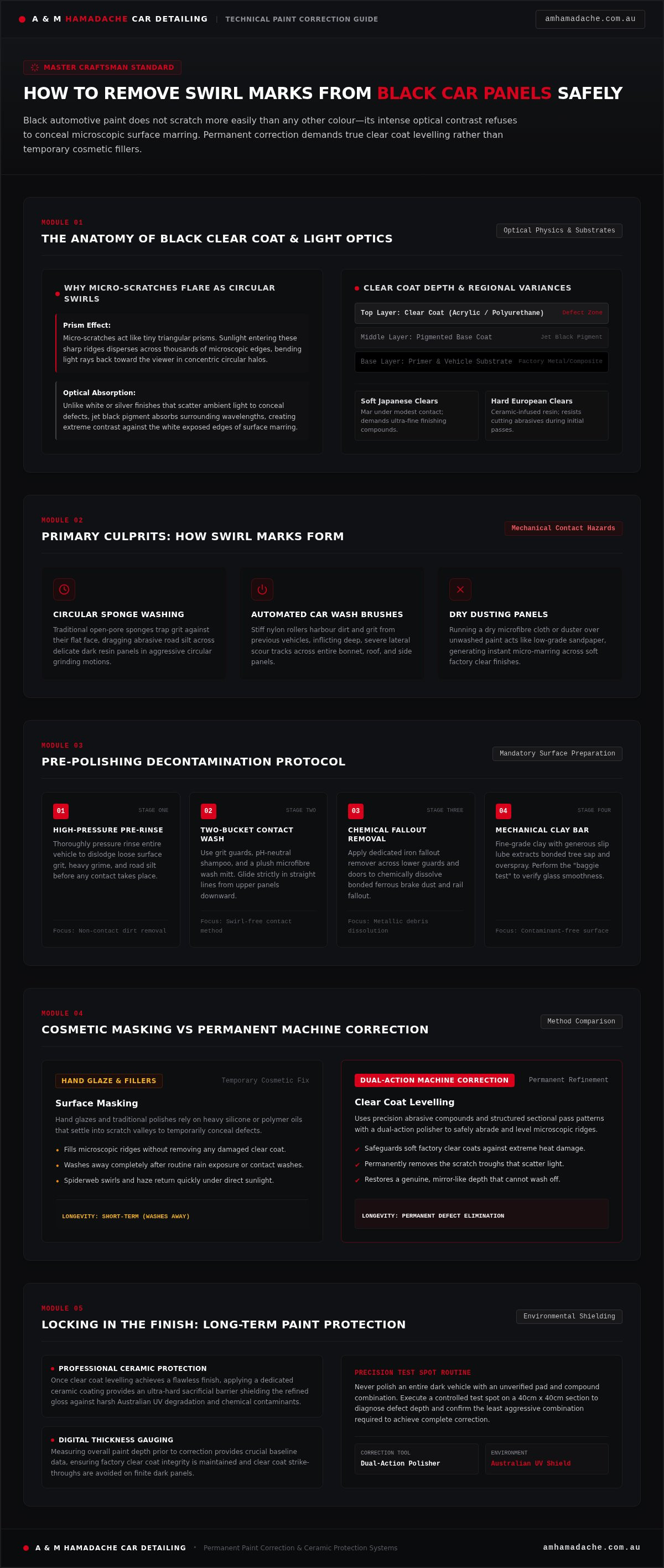
Have you ever inspected your vehicle beneath direct sun or forensic LED lighting, only to see a spiderweb pattern spreading outward from every point of reflection? Swirl marks are microscopic scratches etched directly into the top clear coat layer of your vehicle. While white or silver finishes naturally scatter ambient light to conceal these defects, jet black pigment absorbs surrounding wavelengths, creating intense contrast against the white edges of exposed surface marring. Mastering how to remove swirl marks from black car panels requires understanding how light interacts with clear coat imperfections before touching a pad to the surface.
The Anatomy of Black Automotive Clear Coat
In modern automobile paint structures, the top clear coat serves as an acrylic or polyurethane barrier over the pigmented base coat and primer. Micro-scratches act like tiny triangular prisms. As sunlight enters these sharp ridges, it disperses across thousands of microscopic edges, bending light rays back toward the viewer in concentric circular halos. Paint systems also vary significantly between manufacturers. Soft Japanese clear coats mar under modest contact, whereas hard European ceramic-infused clears resist cutting abrasives. Measuring overall paint depth with a digital thickness gauge before corrective work provides crucial data, preventing clear coat strike-throughs on finite factory finishes.
Primary Culprits: How Swirls Form on Dark Vehicles
Genuine wash-induced marring stems from poor contact technique rather than everyday road exposure. Consider these common pitfalls:
- Circular sponge washing: Traditional open-pore sponges trap grit against the face of the sponge, dragging abrasive road silt across delicate resin panels in circular grinding motions.
- Automated car wash brushes: Stiff nylon rollers harbour dirt from previous vehicles, inflicting deep, lateral scour tracks across entire bonnet and roof surfaces.
- Dry dusting bonnets: Running a dry microfibre cloth over surface dust acts like low-grade sandpaper, generating instant micro-marring across soft finishes.
A single careless contact wash can ruin dozens of hours of careful correction. Learning how to remove swirl marks from black car finishes permanently begins with acknowledging that dark clear coats offer zero margin for mechanical error.
Essential Equipment and Safe Decontamination: Pre-Polishing Preparation
Skipping straight to abrasive polishing without thorough surface decontamination invites disaster. Any rail dust, tar speck, or embedded grit remaining on a dark panel gets picked up by your polishing pad and scoured into the finish. Understanding how to remove swirl marks from black car panels safely demands stripping the paint down to completely bare, contaminant-free resin before spinning a machine.
Two-Bucket Wash and Chemical Decontamination
Begin by rinsing the vehicle thoroughly with a pressure washer to dislodge loose grit. Next, set up two wash buckets fitted with bottom grit guards; one holds your pH-neutral automotive shampoo while the other contains clean rinse water. Use a plush microfibre mitt, gliding in straight lines across upper panels before working down. Once rinsed, apply a dedicated iron fallout remover across lower doors and guards. This chemical dissolves embedded ferrous brake dust on contact. Respected bodies like the Car Care Council highlight the value of structured maintenance routines, especially for preserving delicate clear finishes against environmental fallouts.
Mechanical Clay Bar Treatment for Glass-Smooth Surfaces
Chemical decontamination removes metallic debris, but bonded tree sap and overspray require mechanical claying. Always choose a fine-grade detailing clay paired with generous amounts of dedicated slip lubricant. Stiff or aggressive clay bars will inflict marring on finicky dark paintwork, creating extra correction steps later. To evaluate your progress, slip your fingers into a clean plastic sandwich bag and lightly glide it across the bonnet. Any microscopic bumps you feel through the plastic indicate lingering fallout that requires another gentle pass.
Choosing Your Polishing Machinery, Pads, and Compounds
Leave the heavy rotary buffers to panel repair shops. For enthusiast and precision work, a dual-action random orbital polisher is essential. Its dual motion oscillates while rotating, dispersing friction heat evenly and preventing localized clear coat strike-through. Pair your machine with quality foam or microfibre cutting pads and modern diminishing-abrasive compounds. Complete your kit with a high-CRI inspection light and an isopropyl panel wipe to dissolve masking oils. If handling finicky, razor-thin clear coats feels daunting, seeking a professional paint correction and restoration service guarantees deep clarity without compromising delicate factory layers.
Step-by-Step Guide: How to Remove Swirl Marks from Black Paint Safely
True paint correction permanently levels the clear coat surrounding a scratch until the surface sits completely flat. Many off-the-shelf polishes contain heavy cosmetic oils and glaze fillers that temporarily mask defects, giving the illusion of correction until rain or detergent washes them away. If you want to know how to remove swirl marks from black car paint permanently, you must follow a disciplined, mechanical routine.
Step 1: Execute a Controlled Test Spot
Protect rubber window trims, plastic mouldings, and badge edges using specialised low-tack automotive masking tape. Pick an inconspicuous, flat fifty-centimetre square section on the boot lid or bonnet. Always adhere to the least aggressive method first. Fit your dual-action machine with a medium foam polishing pad and a fine finishing polish. Work the test area, wipe the residue with an isopropyl alcohol panel prep spray to strip lubricating oils, and evaluate the result under direct LED illumination. Only step up to a heavier cutting pad or micro-abrasive compound if noticeable marring persists.
Step 2: The Compounding Phase (Cross-Hatch Method)
Once you determine the ideal combination, follow a strict pass ritual:
- Pad priming: Place three pea-sized drops of compound across your pad face, tapping the pad against the panel before powering on to prevent splatter.
- Cross-hatch pattern: Work within a strict fifty-by-fifty centimetre zone. Move the machine in overlapping horizontal passes at a steady speed of two to three centimetres per second, overlapping by fifty percent, then immediately repeat vertically.
- Pad maintenance: Clear away spent clear coat residue and compound crust after every single section using compressed air or a stiff pad conditioning brush.
Step 3: The Refining and Jewelling Stage
Heavy compounding on dark resin inevitably leaves behind a faint grey micro-haze or light DA sanding trails. Restoring genuine optical depth requires a secondary finishing stage. Switch to a soft, open-cell finishing foam pad paired with an ultra-fine jewelling polish. Lower the machine speed slightly and allow only the weight of the tool to guide the pad across the panels. Complete each section with a slow, featherlight pass. Wipe the panel using a fresh, edgeless 500 GSM microfibre cloth, then perform another thorough isopropyl alcohol inspection. When light reflects cleanly off the panel without a single halo, you have achieved true correction.
DIY Hand Polishing vs Machine Correction: Managing Expectations and Risks
Can sheer elbow grease deliver the same mirror finish as dedicated machinery? When exploring how to remove swirl marks from black car panels, many owners naturally consider hand application out of sheer caution. Understanding the boundary between temporary cosmetic filling and permanent mechanical levelling is critical before investing your weekend.
What Hand Polishing Can and Cannot Achieve on Black Paint
Hand polishing relies almost entirely on filling agents, glazing oils, and heavy waxes. These formulations settle inside micro-scratches, temporarily concealing fine webbing for a handful of wash cycles until weather strips them bare. Achieving true abrasive levelling by hand is virtually impossible; human fingers concentrate pressure into narrow ridges rather than flat planes. This uneven force frequently leaves patchy, blotchy gloss across broad bonnets. Hand application does retain value, however, for working inside recessed door handle cups, around delicate badging, and across narrow pillar trims where machine backing plates cannot safely fit.
Understanding the Risks of Machine Paint Correction
Modern dual-action polishers have removed much of the fear historically linked to mechanical correction. Unlike direct-drive rotary polishers that generate extreme friction heat capable of blistering paint or warping plastic bumper bars, random orbital polishers oscillate safely. If you exert too much downward pressure against an edge, the pad simply stops spinning. Panel creases and styled body lines still demand intense focus. Clear coat naturally pools thinner over sharp body curves during factory baking. Lingering over a swaged body line with an aggressive pad can strike through the clear coat in seconds.
When to Seek Professional Workshop Intervention
Certain defects clearly exceed standard DIY limits:
- The fingernail test: If your fingernail catches inside a scratch, the defect has penetrated into the colour coat and cannot be machine polished away without specialised wet sanding.
- Sub-micron clear coats: Resprayed panels or factory finishes that measure dangerously thin under a digital gauge leave zero margin for abrasive error.
- Severe environmental etching: Hardened bore water spots or baked-in bat droppings often require multi-stage abrasive compounds paired with heavy wool pads.
When factory paint levels are razor-thin, booking your vehicle into a professional paint correction workshop eliminates defects safely while preserving vital clear coat reserves for years to come.
Locking in the Finish: Long-Term Protection and Maintenance for Black Cars
Spending hours perfecting a dark clear coat only to leave the surface exposed is a recipe for heartbreak. Bare automotive paint degrades rapidly under intense Australian ultraviolet rays, leaving the resin soft, porous, and vulnerable to environmental fallout. Understanding how to remove swirl marks from black car panels is only half the battle; locking in that pristine clarity requires establishing a durable sacrificial barrier and adopting a meticulous washing discipline.
Sacrificial Layers: Waxes vs Synthetic Sealants vs Ceramic Coatings
Protection choices determine how well your paint resists future wash-induced marring:
- Natural carnauba wax: Delivers a deep, warm glow on dark tones, but quickly softens and melts when surface temperatures reach sixty degrees under summer sun.
- Synthetic polymer sealants: Provide cross-linked durability that withstands heat and routine washing for several months, yet offer minimal chemical resistance against industrial fallout.
- Gtechniq ceramic coating: Forms a semi-permanent, chemically bonded quartz layer across the clear coat. This slick glass barrier resists chemical etching from bird droppings and drastically reduces micro-marring during future contact washes.
The Flawless Maintenance Routine: Preventing Swirl Marks from Returning
Preventative washing techniques keep your black finish looking showroom-fresh year after year. Always begin with a touchless pre-wash using high-lubricity snow foam. Allow the rich foam to dwell for five minutes, encapsulating surface grit before pressure rinsing from the bottom up. Reserve dedicated buckets and soft wheel woolies exclusively for rims to keep harsh metallic brake dust away from vehicle paintwork. When drying, eliminate friction entirely by using a warm, filtered air blower. If you prefer towels, choose a plush, twisted-loop microfibre towel, patting panels dry rather than dragging material across the surface.
Preserving Vehicle Resale Value Across Sydney's Coastal Climate
Sydney's coastal atmosphere presents constant challenges for vehicle owners. Airborne sea salt combines with coastal moisture to accelerate oxidation on bare clear coat, while persistent UV exposure degrades clear resins. Fortnightly maintenance washes paired with top-tier surface protection preserve the genuine depth achieved during multi-stage correction, safeguarding your car's market value. To explore how to remove swirl marks from black car paint permanently, protect your investment by scheduling an exterior appraisal with A & M Hamadache Car Detailing today.
Restoring Pure Optical Clarity to Your Dark Paintwork
Achieving a flawless, mirror-like depth on dark paintwork requires patience, disciplined decontamination, and methodical machine levelling. As you now know, mastering how to remove swirl marks from black car panels isn't about masking scratches with temporary glazes. It's about surgically levelling microscopic clear coat peaks and locking in that sharp reflection with durable ceramic protection.
When dark panels present severe marring or factory clear coats feel too thin to risk tackling at home, specialist care makes all the difference. Established by the Hamadache family in 1995, our Brookvale detailing workshop brings decades of trusted automotive preservation across Sydney's Northern Beaches. With specialised expertise in multi-stage paint correction and accredited Gtechniq ceramic coating systems, we deliver uncompromising results tailored to your vehicle's exact clear coat characteristics. Restore your vehicle's mirror finish with A & M Hamadache Car Detailing and enjoy deep, enduring gloss on every drive.
Frequently Asked Questions
Can you permanently remove swirl marks from a black car without polishing?
No, you cannot permanently eliminate swirl marks without abrasive polishing. Products claiming to fix swirls without polishing rely on heavy silicones or oils that merely mask the scratches. Once rain or car wash detergent strips these fillers away, the defects reappear. If you want to understand how to remove swirl marks from black car paint permanently, mechanical clear coat levelling through compounding and polishing remains the only genuine solution.
Will hand polishing completely get rid of deep swirl marks on black paint?
Hand polishing cannot generate the sustained, uniform friction needed to level modern automotive clear coats. While rubbing by hand can spread concealing glazes or remove minor road haze, human hands naturally concentrate pressure unevenly across dark panels. This creates patchy, blotchy gloss rather than true defect elimination. Deep swirl marks require the balanced oscillation of a mechanical dual-action machine to flatten scratched clear coat edges safely.
What is the difference between a glaze, a polish, and a cutting compound?
These products feature distinct abrasive grades and chemical functions. A cutting compound contains dense micro-abrasives designed to level heavy clear coat scratches rapidly. A finishing polish uses diminishing, ultra-fine abrasives to refine compounding haze into a deep, sharp gloss. Conversely, a glaze contains no abrasive particles; it uses temporary polymer and oil fillers to mask fine micro-marring visually without removing any physical clear coat material.
How much clear coat is removed during a multi-stage machine paint correction?
A multi-stage paint correction typically removes only two to five microns of clear coat, leaving the vast majority of the factory barrier intact. Because a factory clear coat measures roughly thirty to fifty microns thick, careful levelling preserves structural clear coat reserves. In our Northern Beaches workshop, assessing depth with digital gauges before polishing ensures we eliminate surface marring without ever compromising the vehicle's long-term protection against coastal sun and salt.
Can a ceramic coating stop swirl marks from appearing on black paintwork?
A ceramic coating significantly reduces the risk of swirl marks, but it isn't scratch-proof armour. High-grade systems like Gtechniq ceramic coating create a sacrificial, ultra-slick quartz barrier that resists chemical etching and light friction. This slickness helps wash mitts glide effortlessly across panels, preventing dirt from scouring the paint. However, careless washing with dirty sponges or dry wiping can still scratch the coating itself over time.
Why do swirl marks look like circular spiderwebs instead of straight scratches?
Swirl marks are actually multi-directional, linear scratches rather than perfect circular cuts. They appear circular because of how point-source light, like the sun or a bright workshop torch, reflects off curved scratch edges. Scratches perpendicular to your line of sight catch and reflect light directly back to your eyes. This optical phenomenon creates the illusion of concentric web patterns radiating around every bright highlight across dark, highly reflective paint.
Is it safe for beginners to use a dual-action polisher on black automotive paint?
Dual-action polishers are remarkably safe for beginners because their free-spinning orbital design stops oscillating under heavy pressure, preventing localized heat friction. However, mastering how to remove swirl marks from black car finishes still requires caution around body swage lines and thin plastic edges. For daily drivers across Sydney's coastal Northern Beaches, practising on a scrap panel first helps develop the smooth pass rhythm and clean pad discipline necessary for dark paintwork.


