
If you have just picked up a new vehicle in the Northern Beaches, you've likely asked yourself a difficult question: is a professional ceramic coating worth it, or is it simply an expensive way to avoid a bit of elbow grease? It's a fair concern, especially when you're faced with a dizzying array of brands and promises of a permanent shine. You probably already know that Sydney's harsh UV rays and constant salt air are the natural enemies of your car's paintwork. It's frustrating to spend hours washing and waxing only to see that deep gloss fade under the pressure of coastal living and acidic bird droppings.
This 2026 guide offers a transparent look at the reality of high-end vehicle protection. We believe that a coating is not just a luxury aesthetic upgrade; it's a strategic maintenance tool that preserves your car's resale value and simplifies your life. You'll discover exactly how Gtechniq coatings perform in our local climate and why the secret to a lasting finish always starts with meticulous paint correction. We will break down the true costs, the functional benefits of sea salt protection, and how to choose a specialist who treats your car with the care it deserves.
Key Takeaways
- Understand how Sydney’s unique coastal conditions and high UV levels accelerate paint degradation and why a semi-permanent barrier is your car's best defence.
- Discover the specific factors that make a professional ceramic coating worth it for drivers living in high-salt coastal environments like the Northern Beaches.
- Learn why the quality of the final result depends entirely on the meticulous paint correction and restoration work performed before the liquid polymer is applied.
- Distinguish between marketing hype and reality regarding scratch resistance and the practical "self-cleaning" properties of premium Gtechniq products.
- Identify whether your vehicle maintenance habits and ownership plans make you the ideal candidate for a bespoke ceramic protection package.
The Coastal Challenge: Why Paint Protection Matters in Sydney
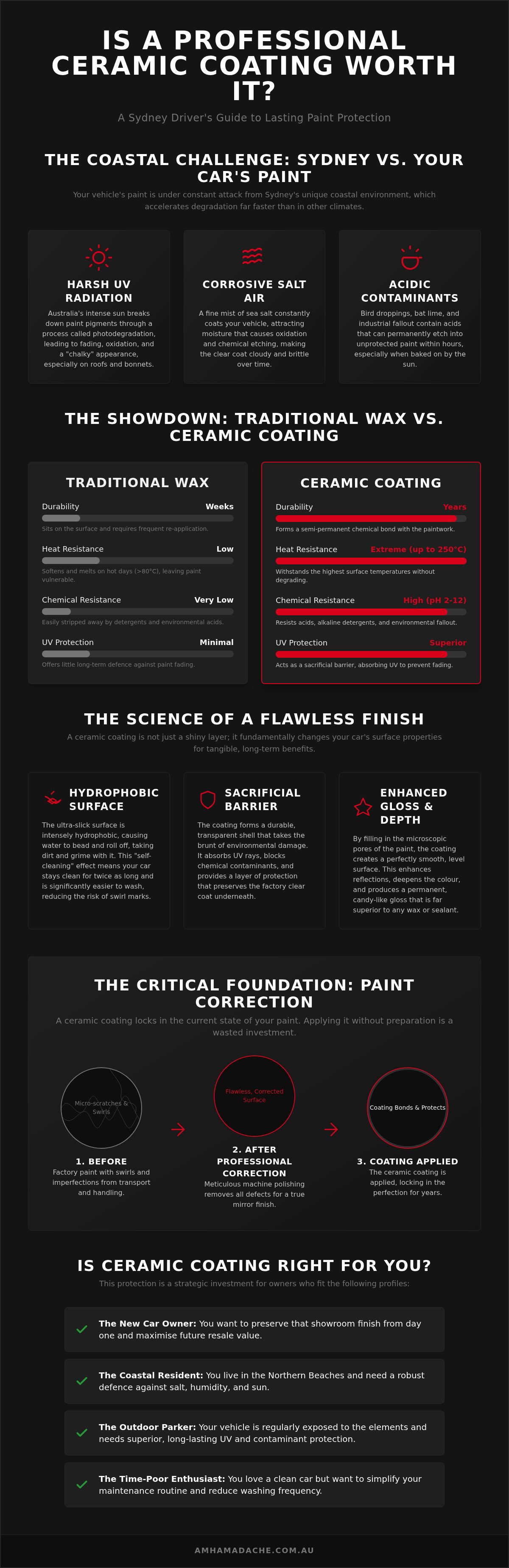
A ceramic coating is a semi-permanent liquid polymer that creates a chemical bond with your vehicle's factory paint. Unlike traditional waxes or sealants that sit on the surface, this coating integrates into the microscopic pores of the clear coat. For many owners, deciding if a ceramic coating worth it involves weighing the initial cost against the relentless environmental pressures of the Northern Beaches. Our local climate is particularly unforgiving; the combination of high UV indices and salt-laden air creates a corrosive environment that can age a new car's finish in months.
Traditional carnauba waxes have served car enthusiasts for decades, but they simply aren't designed for the Australian summer. On a typical 35-degree day in Sydney, the surface temperature of a dark-coloured car can exceed 80 degrees Celsius. At these temperatures, wax softens and eventually melts away, leaving your paint vulnerable to industrial fallout and acidic contaminants like bat droppings and bird lime. These organic acids can etch into the clear coat within hours if not protected by a more resilient, heat-resistant barrier.
The Threat of Salt Air and Oxidation
Living near the coast means your vehicle is constantly bathed in a fine mist of sea salt. This salt is hygroscopic, meaning it attracts and holds moisture against the paint surface. Over time, this leads to oxidation, where the clear coat becomes cloudy and brittle. It's a common misconception that regular washing is a complete solution. While it helps, salt can become ingrained in the paint's texture, leading to chemical etching that no amount of soap can remove. A professional application creates a dense, hydrophobic surface that prevents salt and minerals from finding a foothold in the first place.
UV Protection and Paint Fading
The Australian sun is notorious for its intensity. UV radiation acts as a catalyst for a process called photodegradation, which breaks down the chemical bonds in your car's paint pigments. This is why you often see older cars with "chalky" roofs or bonnets. A premium Gtechniq coating acts as a sacrificial barrier, absorbing the brunt of the UV energy so your paint doesn't have to. By filtering these rays, the coating preserves the original colour depth and gloss. This long-term preservation is a primary reason why many local drivers find a ceramic coating worth it when looking to maintain the showroom finish of a vehicle they intend to keep for several years.
Beyond the Hype: What Ceramic Coating Actually Does for Your Vehicle
To determine if a ceramic coating worth it, you must first separate the marketing fluff from the functional science. It isn't a magical shield, but it is a sophisticated chemical barrier. While many products promise a permanent "showroom shine", the real value lies in how the coating alters the physical properties of your car's surface. By filling the microscopic valleys of your clear coat, it creates a surface that is significantly smoother and more resilient than factory paint alone. This isn't just about aesthetics; it's about changing how your vehicle interacts with the environment.
Hydrophobic Properties and Easy Maintenance
One of the most immediate benefits is hydrophobicity. This is the "self-cleaning" effect where water beads into tight spheres and rolls off the surface, carrying loose dust and light grime with it. Because the surface is so slick, dirt doesn't bond as easily. This means you spend less time with a pressure washer and more time enjoying the drive. More importantly, it reduces the need for aggressive scrubbing. Most paint damage occurs during the wash process; by making the surface easier to clean, you drastically lower the risk of wash-induced marring. A coated vehicle typically stays clean for twice as long as one protected by traditional wax.
Chemical and Thermal Resistance
Beyond the visual appeal, these coatings offer serious industrial-grade protection. High-quality Gtechniq coatings are engineered to withstand extreme temperatures, often up to 250°C, and resist chemical attacks from pH 2 to pH 12. This range is vital for vehicles parked outdoors in the Northern Beaches, where they face everything from acidic rain to harsh alkaline detergents used in some commercial car washes. This chemical stability ensures the protection doesn't strip away after a single wash, unlike a standard sealant. It provides a level of durability that simply can't be matched by over-the-counter products.
We often hear the term "9H Hardness" used as a marketing buzzword. It's important to understand that this refers to the pencil hardness scale, not the Mohs scale used for minerals. While it provides excellent resistance against the fine swirls caused by dust and improper drying, it is not a suit of armour against stone chips or deep scratches. However, the permanent gloss improvement is undeniable. The coating provides a depth of colour and a mirror-like finish that remains consistent year after year. For those deciding whether a ceramic coating worth it, our paint correction and restoration services ensure the surface is perfectly prepared to lock in that clarity before we apply these advanced layers.
The ROI Analysis: Calculating if the Investment Pays Off
When evaluating if a ceramic coating worth it, you have to look beyond the initial invoice. It's helpful to view this as a strategic maintenance choice rather than a one-off aesthetic upgrade. For many Northern Beaches locals, the real value reveals itself over several years of ownership. While the upfront cost of a professional application is higher than a bottle of wax, the long-term financial logic is sound. It's a matter of shifting your perspective from recurring expenses to a one-time investment in preservation.
Ceramic Coating vs. Traditional Wax vs. Sealants
Traditional carnauba wax generally provides protection for about three months before it begins to degrade. To maintain that same level of barrier, you would need to re-apply it at least four times a year. Over a five-year ownership period, that totals twenty separate detailing sessions. Even if you perform the labour yourself, the cost of premium supplies and the sacrifice of your weekend hours add up quickly. Professional ceramic coatings provide a durable bond that lasts five years or more with minimal maintenance. This shift from a quarterly chore to a semi-permanent solution represents a significant saving in both effort and ongoing material costs. You aren't just buying a product; you're reclaiming your time.
Impact on Vehicle Resale and Trade-In Value
The first thing a potential buyer or dealership valuer notices is the condition of the paintwork. A car that has been professionally protected maintains a depth of colour and a lack of swirl marks that unprotected vehicles simply cannot match. This showroom condition often translates into a higher trade-in offer, sometimes by thousands of dollars. In many cases, the difference in resale value can entirely offset the initial cost of the coating. Keeping a record of your professional application from an established specialist also provides proof of meticulous care. It's far more cost-effective to prevent clear coat failure than it is to pay for a full paint restoration later. Ultimately, the peace of mind knowing your vehicle is guarded against acidic bird droppings or environmental contaminants is a dividend that's hard to put a price on.
The Critical Factor: Why Professional Prep Work Defines the Value
The true value of a ceramic coating isn't found in the bottle; it's found in the hours of meticulous labour that occur before the liquid ever touches the car. A coating is only as effective as the surface it bonds to. If you apply a high-end sealant over paint that contains iron filings, rail dust, or industrial fallout, you are essentially sealing those contaminants against your vehicle. This is a primary reason why many people question if a professional ceramic coating worth it after seeing DIY attempts fail. Without a clean, decontaminated surface, the chemical bond is weak, leading to premature failure and a lack of depth in the finish. Our process ensures every microscopic particle is removed before we even begin the application.
What is Professional Paint Correction?
Professional paint correction is the methodical process of using machine polishers and varying grades of abrasive compounds to level the clear coat. We remove microscopic layers of the paint surface to eliminate swirl marks, light scratches, and oxidation. This step is vital because a ceramic coating acts like a magnifying glass. If you apply it over existing defects, you "lock in" those imperfections under a semi-permanent layer that is much harder to remove than standard wax. A specialist "correct and protect" service ensures that the paint achieves maximum clarity and a mirror-like reflection before the protection is applied. For vehicles that have seen better days, our paint correction and restoration service is the essential foundation for any protective layer.
The Importance of a Controlled Environment
Applying a professional-grade coating requires a clinical, controlled environment. Factors such as ambient temperature, humidity levels, and airborne dust can all interfere with the curing process. If a coating is applied in a driveway or an open garage, you risk "high-spotting", which results in dark, oily patches where the product has flashed too quickly, or trapping dust particles under the surface. These errors often require machine sanding to fix. At A & M Hamadache, we utilise a dedicated facility for all Gtechniq applications to ensure the environment is stable and clean. This controlled approach prevents smearing and ensures the coating bonds perfectly to every panel. It is this commitment to precision and craft that ensures your ceramic coating worth it for the long term.
Making the Call: Is Ceramic Coating Right for Your Lifestyle?
Deciding if a ceramic coating worth it ultimately depends on your relationship with your vehicle and your long-term ownership goals. While the technology offers a superior level of protection, it isn't a universal requirement for every driver. We believe in providing honest advice based on how you actually use your car. If you view your vehicle as a long-term asset, or if you simply don't have the time for weekly detailing sessions, this technology becomes a practical necessity rather than a luxury. It's about matching the solution to the specific demands of your daily life in the Northern Beaches.
This investment is ideal for three types of owners. The "keeper" who intends to drive their car for five to ten years and wants to preserve that new-car feeling. The "busy professional" who needs their vehicle to look presentable for clients but lacks the time for constant maintenance. Finally, the "enthusiast" who demands a level of gloss and depth that standard waxes cannot achieve. Conversely, if you plan to trade your car in within twelve months, or if you prefer the convenience of automatic brush car washes, the investment may not be for you. Those aggressive brushes will eventually mar even the most durable coatings, defeating the purpose of the application.
Determining Your Maintenance Personality
Your willingness to follow a basic maintenance routine is a significant factor in the coating's longevity. While a coated car is much easier to clean, it still requires proper technique to avoid surface damage. Are you prepared to use the "two-bucket" wash method and a dedicated microfibre drying towel? If you are, you'll find that a ceramic coating worth it because it drastically reduces the effort required to achieve a perfect result. However, if your car is a "weekend ute" that sees heavy off-road use and is rarely washed, a simpler sealant might be a more appropriate choice. We always take the time to discuss your driving habits before recommending a specific package.
The Hamadache Difference in the Northern Beaches
Since 1995, our family-owned business has focused on the preservation of vehicles in Sydney's most challenging coastal environments. We don't believe in a "one size fits all" approach. Instead, we leverage thirty years of experience to tailor our services to the specific needs of your paintwork. Our commitment to the Gtechniq system is based on its proven durability against sea salt and high UV indices. As accredited installers, we provide a "safe pair of hands" for your vehicle, ensuring that the preparation and application are handled with the meticulous care of a specialist craftsman.
If you're ready to protect your investment and enjoy a car that stays cleaner for longer, we invite you to enquire about our Gtechniq Ceramic Coating packages today. In 2026, ceramic protection remains the gold standard for anyone serious about vehicle preservation. It's a strategic choice that rewards you with a permanent showroom shine and the peace of mind that comes from knowing your paint is guarded by the best technology available.
Protecting Your Vehicle’s Future on the Northern Beaches
Preserving a car in Sydney’s coastal environment requires more than just occasional maintenance; it demands a strategic approach to protection. We have seen how a professional application provides a resilient barrier against the persistent salt air and intense UV radiation that often lead to clear coat failure. When you weigh the long-term protection against the ongoing cost of temporary waxes, it’s clear that a professional ceramic coating worth it for any serious owner. This process isn't just about the immediate aesthetic finish; it’s about maintaining the structural integrity and resale value of your vehicle for the years ahead.
Since 1995, our family-owned team has acted as a "safe pair of hands" for local owners, specialising in Northern Beaches vehicle preservation. As Gtechniq Accredited Detailers, we value precision. We combine high-end technical expertise with a commitment to traditional workmanship on every panel. We invite you to Get a Quote for Gtechniq Ceramic Coating at A & M Hamadache to discuss a bespoke protection package for your car. Take the first step toward a cleaner, more durable finish that stands up to the elements with ease.
Frequently Asked Questions
Does ceramic coating prevent rock chips and deep scratches?
No, it doesn't provide a physical shield against heavy impacts. While the coating offers 9H hardness on the pencil scale, it is not thick or flexible enough to absorb the energy of a flying stone at highway speeds. It is specifically designed to resist fine swirl marks, chemical etching, and environmental stains. For those wondering if a ceramic coating worth it for impact protection, you would need to consider Paint Protection Film instead.
How long does a professional ceramic coating actually last in Australia?
A professional Gtechniq application typically lasts five years or more when maintained with proper care. In the intense UV environment of the Northern Beaches, the actual lifespan depends heavily on the quality of the initial bond and your washing habits. Unlike traditional waxes that degrade within weeks, these coatings create a permanent chemical link with your clear coat that resists the relentless heat of the Australian summer.
Can I still take my car through an automatic car wash after coating?
We strongly advise against using automatic brush car washes. The aggressive nylon bristles often carry grit and contaminants from previous vehicles, which can cause micro-marring even on a hardened surface. Over time, these machines strip away the hydrophobic properties of the layer. To keep your vehicle in showroom condition, we recommend using a pH-neutral soap and the softest microfibre wash mitts available.
Is ceramic coating worth it for an older car with existing paint damage?
It is absolutely worth it, provided you invest in professional paint correction first. Applying a coating over existing scratches will only highlight and "lock in" those defects under a semi-permanent layer. By performing a full restoration to remove oxidation and swirls, we can return an older vehicle to a high-gloss finish before sealing that result for years. It is a strategic way to restore and preserve a valued asset.
How do I maintain my ceramic coating to ensure the warranty stays valid?
Maintenance involves regular, safe washing using the two-bucket method to prevent surface contamination. You should avoid high-alkaline detergents often found in "touchless" car washes, as these can eventually weaken the coating's surface tension. Using Gtechniq-approved maintenance products ensures the hydrophobic layer remains active and effective. Following these simple steps protects your investment and ensures you meet the specific care requirements stipulated in your professional warranty documentation.
What is the difference between a DIY ceramic spray and a professional application?
DIY sprays are generally high-quality sealants that sit on top of the paint and last for several months. A professional application involves a high-solids liquid polymer that bonds into the paint's microscopic pores. The main difference lies in the preparation; we spend hours on chemical decontamination and machine polishing, which a simple spray-on product cannot replicate. This professional prep work is what ensures the coating lasts for years rather than weeks.
How long does the application process take at A & M Hamadache?
The entire process usually takes between two and three days at our Northern Beaches facility. We don't rush the work because the majority of that time is dedicated to meticulous paint correction and decontamination. Once the Gtechniq coating is applied, it also requires a specific period of climate-controlled curing to ensure the bond is fully established before the vehicle is exposed to the coastal elements.
Does ceramic coating protect my car from sea salt and rust?
It provides excellent protection against sea salt etching on the painted exterior surfaces of your car. By creating a hydrophobic barrier, it prevents salt spray from bonding to the clear coat and causing oxidation. However, it does not protect the undercarriage or internal chassis cavities from corrosion. For comprehensive coastal protection, we recommend pairing a ceramic coating worth it for your paint with our chemical or electronic rustproofing solutions.


