
If you’ve ever walked out to your driveway in Manly or Avalon only to find a gritty, white haze masking your car’s true colour, you’ve felt the frustration of coastal living. That fine mist isn't just a cleaning chore; it's an aggressive abrasive that works around the clock to compromise your clear coat. Most locals ask us how to protect car paint from salt air because they’ve seen how quickly the salt can turn a pristine finish into a dull, pitted mess. We agree that while the ocean breeze is a perk of the Northern Beaches, the damage it does to your investment is anything but.
This guide shares the professional secrets we’ve refined since 1995 to shield your vehicle from coastal corrosion and maintain a showroom finish. We will explain the vital differences between traditional wax and Gtechniq ceramic coatings, provide a clear maintenance schedule, and help you decide when a specialist detail or rustproofing is required. Whether you’re worried about plummeting resale value or just want a car that stays clean longer, we’ve outlined the practical steps to keep your vehicle looking its best in our unique local environment.
Key Takeaways
- Learn why a weekly rinse is non-negotiable for Northern Beaches drivers and the specific technique required to avoid scratching your clear coat with salt crystals.
- Discover how to protect car paint from salt air using Gtechniq ceramic coatings, which create a high-performance hydrophobic barrier that prevents corrosion from taking hold.
- Understand the critical role of chemical and electronic rustproofing in defending your vehicle’s chassis and hidden cavities from the invisible threat of salt spray.
- Find out when a professional Full Detail Package or paint correction is necessary to remove existing pitting and restore your vehicle’s showroom shine.
- Establish a sustainable maintenance schedule that balances DIY care with professional expertise to maximise your car’s resale value and long-term durability.
Why Salt Air is Your Car’s Worst Enemy on the Northern Beaches
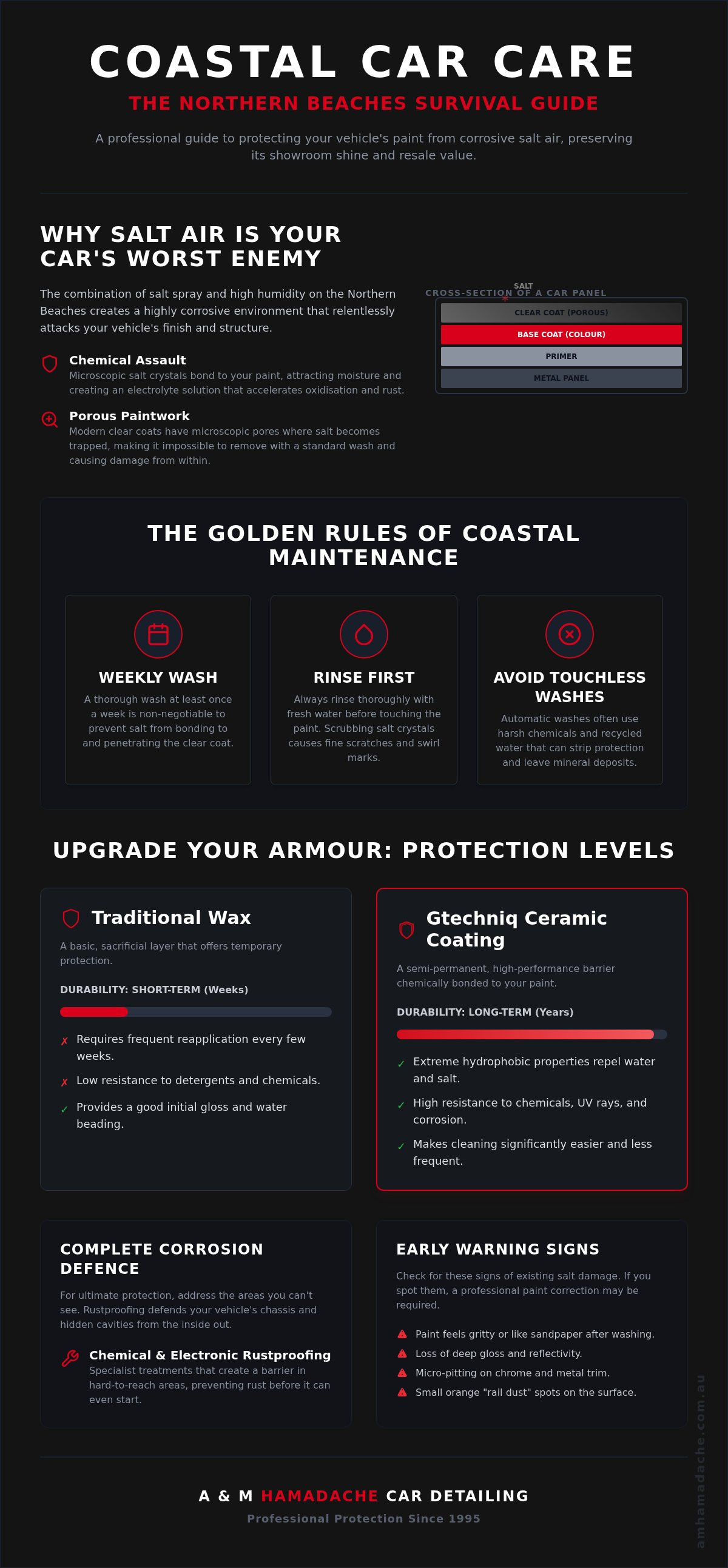
Living along the coastline from Manly up to Palm Beach offers an enviable lifestyle, but for your vehicle, the environment is relentlessly hostile. The "Northern Beaches effect" is a unique combination of high humidity and concentrated salt spray that creates a perfect storm for metal degradation. Unlike inland areas where dust is the primary concern, coastal air carries microscopic sodium chloride crystals that bond to every surface they touch. This isn't just a matter of aesthetics; it's a chemical assault on your car's structural integrity.
Salt air acts as a powerful catalyst, accelerating the natural process of oxidisation. When salt particles land on your vehicle, they don't just sit there. They are hygroscopic, meaning they actively pull moisture from the humid Sydney air and hold it against the metal. This creates an electrolyte solution that triggers galvanic corrosion. Many owners ask how to protect car paint from salt air because they notice their car's finish deteriorating much faster than those parked just a few kilometres inland. The damage usually targets specific vulnerable zones:
- Paint pores: Microscopic openings in the clear coat where salt becomes trapped.
- Wheel arches: Areas that collect road grime and salt, holding moisture against the chassis.
- Metal trim: Chrome and polished aluminium that can pit and flake when exposed to salt spray.
It is vital to distinguish between surface salt and deep-seated corrosion. Surface salt is the visible white crust you see after a windy day at the beach. While unsightly, the real danger lies in the salt that migrates into hidden cavities, such as inside door panels or along the chassis. This deep-seated corrosion often goes unnoticed until structural damage has already occurred, which is why a proactive defence is the only way to maintain your car's value.
The Chemistry of Coastal Corrosion
Modern clear coats are surprisingly porous. To the naked eye, they look like a solid sheet of glass; under a microscope, they are full of tiny openings. Salt becomes trapped in these pores, making it difficult to remove with a standard wash. Once embedded, these particles attract moisture directly into the paint layers. On white or silver cars, this damage is often invisible until the corrosion has reached the underlying metal. By the time you see the damage, it has often moved beyond a simple cleaning fix.
Signs Your Paint is Already Under Attack
Identifying the early warning signs of salt damage can save you thousands in restoration costs. If your paint has lost its deep gloss and feels gritty or like sandpaper even after a wash, salt and industrial fallout have likely bonded to the surface. You might also notice micro-pitting in the chrome trim or the appearance of "rail dust." These are small orange spots that look like rust but are actually metal particles that have oxidised on top of your paintwork, fuelled by the salty atmosphere. Understanding how to protect car paint from salt air starts with recognising these subtle changes before they become permanent defects.
The Golden Rules of Coastal Car Maintenance
Maintaining a vehicle on the Northern Beaches requires more than a casual hose-down. When considering how to protect car paint from salt air, consistency is your most powerful tool. If your car is parked outdoors near the coast, we recommend a thorough wash at least once a week. This prevents the salt from bonding to the clear coat and beginning the corrosive process described earlier. Even if the car looks clean, that invisible layer of sodium chloride is working against your finish every hour it sits on the panels.
The most critical step in any coastal wash is the initial rinse. You must never touch the paintwork with a sponge or mitt until every trace of surface salt has been flushed away. Salt crystals are jagged and abrasive. If you skip the rinse, you are essentially rubbing sandpaper over your paint, leading to fine scratches and swirl marks that dull the finish over time. Use a steady stream of water to clear the wheel arches and undercarriage particularly well, as these areas trap the most salt spray.
While "touchless" automatic car washes seem convenient, they can often do more harm than good. These facilities frequently use recycled water that may still contain high mineral levels or residual salt. Additionally, the harsh chemicals required to clean without agitation can strip away existing waxes or sealants, leaving your paint even more vulnerable. For a truly safe reset, a professional Full Detail Package ensures every trace of coastal grime is safely removed using specialised lubricants and techniques.
Effective Washing Techniques for Salt Removal
To ensure a safe clean, we advise using the two-bucket method. One bucket contains your pH-neutral soap, while the second is for rinsing your wash mitt. This prevents you from transferring salt particles back onto the panels. Using a pH-neutral snow foam is also highly effective; it clings to the surface and lifts salt spray before you even touch the car. Don't forget the hidden zones where salt accumulates. Door jambs, fuel caps, and window seals are notorious for trapping moisture and salt, leading to rust in places you won't see until it's too late.
Proper Storage and Sheltering Advice
Sheltering your car is a significant advantage, but it comes with caveats. A garage or carport provides a physical barrier against salt mist, yet proper ventilation is essential. If you park a salty car in a humid, unventilated garage, you've created a hothouse for corrosion. We also advise against using car covers on vehicles parked near the beach. If even a small amount of salt is trapped between the cover and the paint, the wind will cause the cover to vibrate, creating a destructive "sandpaper effect." If your car sits idle outdoors, give it a quick fresh-water rinse every few days, even if you haven't driven it. This simple act keeps the salt concentration low and buys your paintwork valuable time.
Ceramic Coating: The Ultimate Shield Against Salt Corrosion
Regular maintenance is your first line of defence, but for those living within a few hundred metres of the ocean, a more permanent solution is often required. This is where high-grade protection becomes a strategic investment rather than just a cosmetic choice. Gtechniq ceramic coating acts as a semi-permanent barrier that salt simply cannot penetrate. Unlike the porous clear coat found on modern vehicles, ceramic coatings create a dense, glass-like surface that seals the paintwork entirely. It's a sophisticated way to manage how to protect car paint from salt air while significantly reducing your weekly cleaning workload.
The magic of ceramic technology lies in its hydrophobic properties. Water and salt spray don't just sit on the surface; they bead up and roll off, taking most of the salt crystals with them. This prevents the "white haze" from bonding to your panels in the first place. However, the application process is just as important as the product itself. Before we apply any long-term protection, professional paint correction is non-negotiable. We must ensure the surface is chemically clean and free of existing pitting or oxidation. Applying a coating over salt residue would merely seal the damage in, allowing corrosion to continue unseen beneath the protective layer.
Why Gtechniq is the Professional Choice
Gtechniq coatings aren't just a layer sitting on top of your car; they form a molecular bond with the clear coat. This creates a harder, more resilient surface that withstands the abrasive nature of salt air much better than factory finishes. In the intense Australian sun, the UV protection offered by Gtechniq is equally vital. It prevents the clear coat from becoming brittle and chalky, which is often the first step toward coastal corrosion. Our professional application ensures a flawless finish, providing the peace of mind that your vehicle is truly shielded by a specialist who understands the local conditions.
Ceramic Coating vs. Traditional Sealants
Traditional waxes often fail in the Sydney heat. Most carnauba waxes begin to soften or "melt" at temperatures as low as 60 degrees Celsius, which a dark car can easily reach when parked at the beach. Once the wax softens, salt particles can become embedded in the layer itself, making it almost impossible to wash off safely. Ceramic coatings remain stable at much higher temperatures, keeping the barrier intact. While the initial investment is higher than a tin of wax, the multi-year durability of ceramic means you aren't reapplying protection every few months. It maintains that "just detailed" look and deep gloss despite the constant sea breeze on the Northern Beaches, representing a long-term strategy for preserving your car's resale value.
Rustproofing: Protecting the Chassis and Hidden Cavities
While the glossy exterior often gets the most attention, the true threat to a coastal vehicle’s longevity lies beneath the surface. The #1 fear for many Northern Beaches car owners is the underbody rusting out, a process that can go undetected for years until it becomes a structural failure. Salt air doesn't just rest on the roof; it swirls into the wheel arches and settles on the chassis. For those who frequently use boat ramps or drive 4WDs along the shoreline, the risk is even higher. Understanding how to protect car paint from salt air is only half the battle; the other half is securing the metal components that hold your vehicle together.
Chemical Rustproofing for the Northern Beaches
Chemical rustproofing acts as a physical barrier between the metal and the salty atmosphere. This process involves the application of specialised, heavy-duty waxes and oils to the undercarriage and internal cavities. These substances are designed to "creep" into welds, seams, and tight joints where salt air tends to linger and cause the most damage. Unlike a standard wash, these oils don't just rinse away; they stay active, displacing moisture and preventing oxygen from reaching the metal surface. Chemical rustproofing is the most reliable "boots on the ground" protection for coastal Sydney. It is particularly effective for vehicles that endure the daily grind of salt-laden roads or the occasional splash of seawater at a boat ramp.
Electronic Rust Protection Systems
For a more comprehensive defence, we often recommend electronic rust protection. These systems work by using either impressed current or capacitive coupling to interfere with the electrochemical process of oxidation. In simple terms, it makes it much harder for the rust reaction to take hold on the metal. When you combine an electronic system with a chemical barrier, you create a "dual-layer" protection that is far superior to any single method. This is especially beneficial for daily commuters on Pittwater Road, where the air is thick with salt, but the vehicle doesn't always get the immediate rinse it needs. If you want the highest level of security for your investment, you can explore our professional Chemical and Electronic Rustproofing solutions today.
Professional Restoration and Protection Strategies
While the washing habits and protective coatings we’ve discussed are essential, there is a limit to what a standard hose and sponge can achieve. If you are wondering how to protect car paint from salt air over the long term, a professional intervention is often the best way to reset the clock. Over time, salt and industrial fallout become so deeply embedded in the paintwork that they require mechanical decontamination. This is where professional paint correction becomes vital. By carefully removing a microscopic layer of the clear coat, we eliminate pitting and oxidation, ensuring the surface is perfectly smooth before any new seal is applied.
It is also a mistake to overlook the interior of the vehicle. Salt air travels through open windows and air conditioning vents, settling on leather, fabric, and trim. This salt-laden humidity can weaken the adhesives in your car’s ceiling, leading to the common sagging headliner seen in many coastal vehicles. We provide specialised headlining repairs and trim restoration to ensure the inside of your car remains as pristine as the outside. Choosing a local specialist who understands these specific Northern Beaches challenges is the difference between a quick clean and a genuine restoration.
The Full Detail Package: A Coastal Reset
A professional detailer uses tools and chemical cleaners that aren't typically found in a home garage. In our Full Detail Package, we utilise clay bars and specialised fallout removers to strip away contaminants that have bonded to the surface. We also pay close attention to the rubber sunroof seals and plastic trims that the Sydney sun and salt air tend to harden and crack. If these components aren't regularly treated, they can lead to leaks or brittle trim that eventually requires replacement. Our process ensures every nook and cranny is free of salt residue.
Long-Term Value Preservation
Ultimately, professional care is about protecting your investment. A vehicle with a documented history of professional detailing and rustproofing commands a much higher price on the used market here in Sydney. Buyers on the Northern Beaches are savvy; they look for signs of salt damage and underbody corrosion. When you can show your car has been cared for by a family-owned business established in 1995, it provides an immediate sense of security. We take pride in our workmanship and the long-term relationships we've built with local car owners. If you're ready to secure your vehicle’s future, Book your coastal protection assessment today and let our team provide the meticulous care your car deserves.
Secure Your Vehicle’s Future on the Coast
Living on the Northern Beaches shouldn't mean sacrificing your car's finish to the elements. By combining a disciplined washing routine with advanced protective barriers, you can successfully manage how to protect car paint from salt air and keep your investment looking its best. It's about more than just aesthetics; it's about the long-term preservation of your vehicle's structural integrity. Whether you choose the invisible shield of a Gtechniq ceramic coating or the security of professional rustproofing, taking proactive steps now prevents costly restoration work later.
As a family-owned business operating since 1995, we bring decades of local expertise to every vehicle we service. Our status as Gtechniq Accredited Detailers ensures your car receives the highest standard of care available on the coast. We take professional pride in helping our neighbours maintain their vehicles in showroom condition despite the challenging environment. Protect your pride and joy from the salt air; book a Full Detail or Gtechniq coating with A & M Hamadache today. With the right professional strategy in place, you can enjoy the coastal lifestyle with total peace of mind.
Frequently Asked Questions
How often should I wash my car if I live near the beach?
You should wash your car at least once a week if you live on the Northern Beaches. For vehicles parked outdoors near the shoreline, salt accumulates on every surface daily. A weekly wash prevents sodium chloride from bonding to the clear coat and starting the corrosive process. It is essential to perform a thorough fresh-water rinse before using any wash mitt to ensure salt crystals don't scratch the paintwork. This routine is the most basic step in how to protect car paint from salt air.
Does a ceramic coating really stop salt air damage?
Yes, a Gtechniq ceramic coating provides a high-performance barrier that salt cannot penetrate. Unlike traditional wax, which can soften in the Sydney heat, ceramic coatings remain stable and create a dense, glass-like surface. This prevents salt spray from reaching the clear coat and makes routine cleaning much easier. The hydrophobic properties ensure that salt-laden water beads up and rolls off rather than drying into a corrosive haze on your panels, offering superior long-term protection.
Can I just use a car cover to protect my paint from salt?
We generally advise against using car covers in coastal environments unless the vehicle is perfectly clean. If even a small amount of salt dust settles on the car before you cover it, the wind will cause the cover to vibrate. This creates a destructive "sandpaper effect" that ruins your finish. Additionally, covers can trap humid, salty air against the metal, which actually accelerates the corrosion process in hidden seams and door jambs rather than preventing it.
Is electronic rustproofing actually effective for coastal cars?
Electronic rustproofing is highly effective when used as part of a dual-layer strategy. It works by interfering with the electrochemical process of oxidation, making it harder for rust to form on the metal components. For daily commuters on Pittwater Road, this system provides constant protection even when you can't wash the car immediately. For the best results on the Northern Beaches, we recommend combining electronic systems with a professional chemical rustproofing barrier for the undercarriage and wheel arches.
What is the best way to remove salt spray from my windows and paint?
The safest method is a thorough pre-rinse with fresh water followed by a pH-neutral snow foam. This lifts the salt particles away from the surface without friction. After the foam has dwelled, use the two-bucket wash method with a high-quality lubricant. This ensures you aren't rubbing abrasive salt crystals back onto the paintwork. For windows, a dedicated glass cleaner used after the main wash will remove any remaining mineral streaks and salt residue safely and effectively.
Does salt air affect the interior of my car as well?
Salt air definitely affects your cabin. It enters through open windows and vents, settling on leather, fabric, and plastic trim. The high humidity and salt concentration can cause leather to dry out and adhesives to fail. This is why many coastal cars suffer from sagging headliners or brittle dashboard components. Regular interior detailing and the use of UV protectants are necessary to prevent the salt air from degrading your car's internal components and its overall resale value.
How much does it cost to professionally rustproof a car in Sydney?
The cost of professional rustproofing depends on the size of your vehicle and whether you choose chemical, electronic, or a combined system. While we don't provide flat rates here, a professional assessment is necessary to determine the specific needs of your 4WD or passenger car. Investing in this protection is a strategic way to preserve the structural integrity and long-term resale value of any vehicle frequently exposed to the intense Northern Beaches atmosphere and salt spray.
What happens if I don’t wash the salt off my car?
Neglecting salt removal leads to rapid clear coat failure and structural corrosion. The salt acts as a catalyst for oxidation, pulling moisture into the paint's pores and attacking the metal underneath. Over time, you will notice a permanent loss of gloss, followed by micro-pitting and the appearance of orange rust spots. Once corrosion takes hold in the chassis or seams, the repairs are significantly more expensive than a regular maintenance schedule and can compromise vehicle safety.


