
Would you pay for a premium ceramic coating only to have it permanently seal every swirl mark and scratch into your car's finish? It's a common mistake that leaves many owners frustrated when their expensive investment fails to deliver that deep depth of colour and mirror-like showroom shine. If you've been researching paint correction vs ceramic coating, you've likely encountered a sea of confusing jargon and conflicting advice. We understand the hesitation; nobody wants to waste money on a treatment that doesn't address the underlying damage from the harsh Northern Beaches sun and salt air.
At A & M Hamadache, we believe you deserve clarity before you commit to a service. This article will help you discover the critical differences between restoring your paint and protecting it, ensuring you choose the right investment for your vehicle's specific condition. We'll explain the mechanical restoration of correction, the chemical shielding of Gtechniq coatings, and how these two processes work in tandem to preserve your car's resale value and make weekend washing a breeze. By the end, you'll know exactly which path leads to the best results for your pride and joy.
Key Takeaways
- Learn why paint correction is a subtractive restoration process while ceramic coating acts as an additive shield for your car's exterior.
- Understand the critical choice of paint correction vs ceramic coating to ensure you don't permanently seal existing scratches under a glass-hard layer.
- Discover how professional Gtechniq coatings provide essential protection against the harsh UV rays and corrosive salt air common on the Northern Beaches.
- Identify the risks of DIY kits and why a meticulous, workshop-based application is necessary to avoid unsightly streaks and "high spots".
- Gain the clarity needed to select a bespoke treatment plan that maximises your vehicle's resale value and significantly reduces maintenance time.
Understanding the Basics: Paint Correction vs Ceramic Coating Explained
Many car owners on the Northern Beaches find themselves at a crossroads when deciding how to best care for their vehicle's finish. There is often a misunderstanding that these two services are interchangeable or that one can replace the other. To choose the right investment, you must first understand that they perform two entirely different roles in the world of automotive exterior detailing.
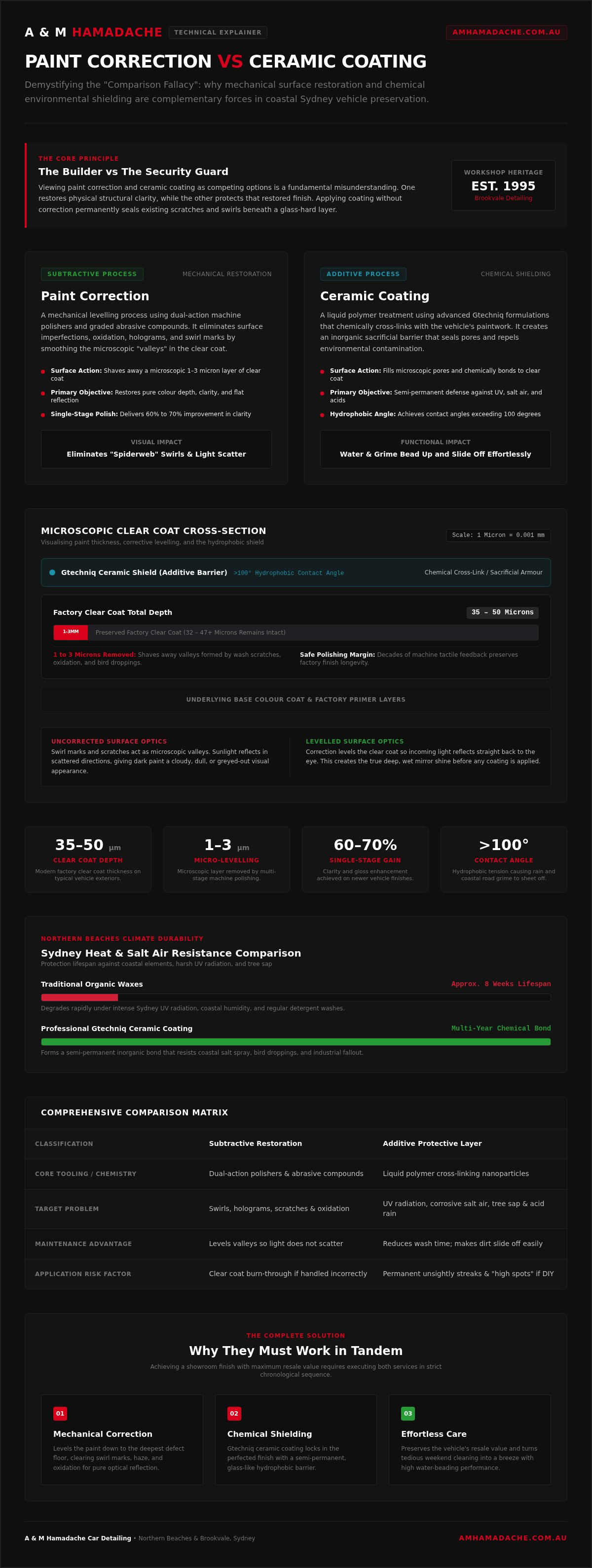
Paint correction is a mechanical restoration process that levels the clear coat to remove surface defects, such as swirl marks and oxidation, restoring the paint's original clarity and depth.
Ceramic coating is a liquid polymer treatment that chemically bonds to a vehicle's factory paint, creating a semi-permanent, hydrophobic protective layer that shields the surface from environmental damage.
This leads to what we call the "Comparison Fallacy." Viewing paint correction vs ceramic coating as a competition is like choosing between a builder and a security guard. One restores the structure, while the other protects it. They are complementary services that, when combined, produce the most durable and visually stunning results possible for your vehicle.
What is Paint Correction Exactly?
Paint correction is a subtractive process. It involves using professional-grade machine polishers and graded abrasive compounds to carefully shave away a microscopic layer of the clear coat. Modern factory clear coats are remarkably thin, usually measuring between 35 and 50 microns. Our specialists typically remove only 1 to 3 microns to eliminate the imperfections that make your paint look dull or "greyed out" in the sun.
Industry professionals often refer to this as "paint rejuvenation" or "multi-stage polishing." By levelling the surface, we remove the "valleys" created by scratches and swirl marks. This allows light to reflect perfectly off the paint, restoring the deep, rich colour that defines a showroom finish. Without this step, even the most expensive coating will simply seal those defects in place, making them permanently visible under the new protective layer.
What is Ceramic Coating Exactly?
While correction is subtractive, ceramic coating is additive. Products like our Gtechniq range are designed to fill the microscopic pores of your paintwork and cross-link with the surface. Once cured, this inorganic layer acts as a sacrificial barrier against the elements. It provides a hydrophobic contact angle of over 100 degrees, meaning water and road grime bead up and slide off with ease.
In our coastal environment, this protection is vital. Traditional waxes might last 8 weeks in the Sydney heat, but a professional ceramic coating maintains its bond for years. It offers a level of chemical resistance that shields your paint from acidic bird droppings, tree sap, and the corrosive salt air that is a constant presence in Brookvale and surrounding suburbs. It doesn't just make the car look better; it makes the vehicle significantly easier to maintain and wash.
The Art of Paint Correction: Restoring That Showroom Shine
Have you ever looked at your car under direct sunlight and seen what looks like a spiderweb of fine scratches? These are swirl marks, and they are usually joined by holograms from poor previous detailing or oxidation that makes dark paint look cloudy. Our goal with paint correction is to create a perfectly flat surface. When the clear coat is level, light reflects directly back to your eye rather than scattering in different directions. This is the secret to achieving that deep, wet look that defines a premium finish.
When weighing up paint correction vs ceramic coating, remember that the correction phase is where the true transformation happens. We use professional dual-action polishers and varying grades of abrasive compounds to refine the finish. It requires a "safe pair of hands" to ensure we don't burn through the factory clear coat. With our workshop established in 1995, we've spent decades mastering the tactile feedback of the machine to ensure every pass is precise and safe for your specific paint type.
Stages of Correction: From Enhancement to Full Restoration
A single-stage machine polish is often sufficient for newer vehicles to remove light haze and boost gloss. It typically achieves a 60 to 70 percent improvement in clarity. However, older cars or those with significant "love marks" from automatic car washes usually require a multi-stage process. This involves a heavy "cut" to level deeper defects, followed by a fine finishing polish to restore mirror-like clarity. Understanding what ceramic coatings do for vehicle paint helps explain why this step is vital. A coating is transparent; it won't hide these marks, it will only highlight them.
The Importance of Surface Decontamination
You can't polish a surface that isn't surgically clean. Even after a thorough wash, paint often feels "gritty" to the touch. This is caused by embedded iron filings from brake dust and industrial fallout common in urban environments. We use specialised clay bars and chemical decontaminants to pull these particles out of the paint pores. Polishing over these contaminants would be like rubbing sandpaper across your finish, causing more harm than good. This meticulous preparation ensures the paint is perfectly prepped for the next phase of protection. If you're unsure which stage your vehicle requires, our paint correction and restoration specialists can provide a bespoke assessment of your car's current condition.
The Science of Ceramic Coating: Long-Term Armour for Your Exterior
Unlike traditional waxes that sit on the surface, professional ceramic coatings like our Gtechniq range create a semi-permanent chemical bond with the clear coat. This is a critical distinction in the paint correction vs ceramic coating debate. While the correction restores the surface, the coating acts as a glass-like shield that becomes a functional part of your vehicle's exterior. This bond is measured at a molecular level, providing a level of durability that organic sealants simply cannot match.
The visual payoff is immediate and striking. A high-quality coating creates a permanent "wet look" that enhances the depth of your paintwork. This optical clarity is paired with extreme hydrophobicity. With a water droplet contact angle often between 100 and 115 degrees, rain and road grime struggle to cling to the surface. This creates a "self-cleaning" effect where contaminants are frequently washed away by the water itself, keeping your car looking cleaner for significantly longer between washes. It's the most effective way to lock in the results of your paint correction vs ceramic coating investment.
Why We Recommend Gtechniq for Northern Beaches Drivers
Living on the coast presents unique challenges for any vehicle finish. The intense Australian UV radiation and constant airborne salt spray from the Pacific Ocean can quickly oxidise unprotected paint. We specialise in Gtechniq application because it aligns with professional detailing industry standards for chemical and environmental resistance. It provides a robust barrier against the corrosive effects of salt air and prevents the sun from fading your car's vibrant colour, making it the gold standard for our local conditions.
The Curing Process and Maintenance
Applying a ceramic coating isn't a simple spray and wipe job. It requires a climate-controlled, dust-free environment to "flash" and harden correctly. A professional installation includes a mandatory 12 to 24-hour indoor curing window where the chemical cross-linking takes place. Without this controlled environment, moisture or dust can interfere with the bond, leading to premature failure or unsightly streaks.
Once cured, the coating changes your maintenance routine. You'll find you no longer need heavy scrubbing or aggressive chemicals to remove dirt. However, it's vital to set realistic expectations. While these coatings are incredibly hard, they are not "scratch-proof." They provide significant resistance against light marring and chemical etching from bird droppings, but they still require careful hand washing to maintain their mirror-like finish over the long term.
The Comparison: Choosing the Right Path for Your Vehicle
Deciding on the best course of action for your car isn't as simple as picking a service from a price list. The choice between paint correction vs ceramic coating depends entirely on the current state of your clear coat. If you choose to apply a ceramic coating over paint that is riddled with swirl marks or oxidation, you are essentially "glassing over a dirty floor." Because professional coatings are optically clear, they will lock those defects in place, making them even more prominent under the new, glossy layer.
To understand what your vehicle truly needs, we suggest performing a "Sun Test." On a clear day, park the car in direct sunlight and look at the reflection on the bonnet. If you see a "spiderweb" pattern of fine scratches radiating from the centre of the sun's reflection, your paint requires mechanical correction. In our Brookvale workshop, we use high-intensity LED inspection lamps to reveal these holograms and marring that standard garage lighting often misses. Our decision matrix is simple: a classic restoration or a neglected daily driver needs correction first, while a brand-new car focuses on immediate protection.
When to Prioritise Paint Correction
You should focus your investment on paint correction if your vehicle's finish looks dull, greyed out, or feels rough to the touch. These are signs of heavy contamination and surface damage that a coating cannot fix. Restoration is also the priority if you're preparing a vehicle for resale. A car with a flawless, mirror-like finish suggests a history of meticulous care, which can significantly increase the final sale price. Once we have levelled the clear coat and restored the depth of colour, the car is ready for a protective shield.
When Ceramic Coating is the Primary Focus
For owners of brand-new vehicles, the priority shifts toward preservation. Even a car straight from the dealership often requires a very light polish to remove transit marks, but the goal is to apply long-term armour from day one. Ceramic coating is also the primary focus for those who want to reclaim their weekends. Because the coating is hydrophobic and chemically resistant, it prevents road grime and salt air from bonding to the surface. This makes your routine maintenance wash faster and much more effective. If you want to ensure your vehicle receives the right sequence of care, you can explore our Full Detail Package for a comprehensive restoration and protection solution.
The Hamadache Standard: Why Professional Application Matters in Sydney
Since 1995, our family-owned workshop in Brookvale has been a staple of the Northern Beaches automotive community. We've spent nearly three decades refining our approach to vehicle restoration, moving away from high-volume detailing to focus on bespoke craftsmanship. When you evaluate paint correction vs ceramic coating, the expertise of the person behind the machine is just as important as the products they use. We view ourselves as trusted advisors, ensuring every vehicle receives the specific care its condition demands.
A common frustration we see involves owners who have tried DIY ceramic kits. While the marketing makes it look easy, these products often lead to "high spots," which are dark, oily-looking streaks that occur when the coating isn't levelled correctly before it flashes. Because professional coatings are designed to be semi-permanent, removing these mistakes usually requires a heavy machine polish, which unnecessarily thins your factory clear coat. We take a different approach by measuring the thickness of your paint before we begin, ensuring we only remove what is absolutely necessary to achieve a flawless finish.
Our Meticulous Process in Brookvale
A significant advantage of our service is our fixed workshop location. Unlike mobile detailing, which is subject to wind, dust, and fluctuating temperatures, our Brookvale facility allows us to control every aspect of the environment. We use specialised high-intensity lighting to reveal every hologram and swirl mark, ensuring nothing is missed. This controlled setting is also vital for the curing phase of a Gtechniq application, as consistent temperature and humidity are required for perfect adhesion to the paint pores. Our Full Detail Package serves as the ultimate foundation for this work, ensuring the interior and engine bay match the excellence of your new exterior finish.
Protecting Your Investment Long-Term
Viewing car care as a strategic investment rather than a chore is the key to preserving resale value. In our coastal region, the combination of professional paint protection and our chemical or electronic rustproofing services provides a comprehensive shield for your vehicle. By addressing both the aesthetic and the structural integrity of the car, you ensure it remains in peak condition for years to come. This "safe pair of hands" approach is what has allowed us to build long-term relationships with local owners who value reliability and meticulous work. If you're ready to see what your car is truly capable of, organise a professional paint inspection with A & M Hamadache today.
Secure the Long-Term Value of Your Vehicle
Choosing between paint correction vs ceramic coating doesn't have to be a guessing game. You now understand that correction is the essential restoration step that removes defects, while ceramic coating is the durable armour that shields your paint from our harsh coastal environment. By following this sequential approach, you avoid the common pitfall of sealing in imperfections and instead achieve a finish that is both beautiful and resilient.
As a family-owned and operated business in the Northern Beaches since 1995, we bring over 30 years of local heritage to every vehicle we touch. We take professional pride in being a Gtechniq Accredited Applicator, providing a meticulous level of care that high-volume mobile detailing simply cannot match. Whether you drive a brand-new car or a cherished classic, we're here to provide the bespoke treatment your vehicle deserves.
Restore and protect your vehicle with our specialist detailing services. We look forward to helping you achieve a showroom finish that stands the test of time.
Frequently Asked Questions
Does ceramic coating remove scratches and swirl marks?
No, ceramic coating doesn't remove existing scratches or swirl marks. It's a transparent protective layer that bonds to the surface, meaning it will actually highlight any defects left underneath. To eliminate those spiderweb marks and restore clarity, you need a mechanical paint correction before the coating is applied. This ensures the protection is locked over a flawless finish rather than sealing in the damage.
How long does a professional paint correction take to complete?
A professional paint correction usually takes between 12 and 30 labour hours depending on the vehicle's size and condition. It's a meticulous process. A single-stage enhancement might be finished in a day, but multi-stage restoration for a classic or neglected daily driver requires work over 48 hours. We take the time needed to safely level the clear coat without rushing, ensuring a consistent result for every Northern Beaches client.
Can I apply a ceramic coating myself at home?
You can buy DIY kits, but applying them at home is risky without a controlled environment. Professional coatings like Gtechniq require surgical surface decontamination and a dust-free workshop to bond correctly. Without proper lighting and temperature control, you're likely to end up with "high spots" or permanent streaks. Our Brookvale facility provides the stable conditions needed for the chemical cross-linking that ensures the coating's longevity and performance.
How much does paint correction vs ceramic coating cost in Sydney?
When evaluating paint correction vs ceramic coating costs in Sydney, the total investment isn't a fixed figure. It depends on your vehicle's size and current condition. Factors like the number of correction stages required and the specific grade of coating chosen will influence the final price. We provide bespoke assessments at our workshop to give you an accurate estimate. This ensures you only pay for the restoration your vehicle actually requires.
Will ceramic coating prevent stone chips on my car?
Ceramic coating won't prevent stone chips or deep impacts. While it's incredibly hard and provides excellent chemical resistance, it's only a few microns thick. It's designed to shield your paint from UV rays, salt air, and bird droppings rather than physical debris at highway speeds. For owners concerned about stone chips on the Northern Beaches, we recommend discussing a combination of protective measures to ensure total exterior peace of mind.
How often do I need to wash my car after it has been ceramic coated?
You should still wash your car every one to two weeks, even after a professional paint correction vs ceramic coating service. The hydrophobic properties create a 'self-cleaning' effect that repels road grime, making the actual wash much faster and easier. You'll find that dirt slides off with minimal effort, which reduces the risk of marring the finish. Regular maintenance ensures the coating stays clear of contaminants and performs at its peak.
Is paint correction safe for older cars or thin clear coats?
Paint correction is safe for older vehicles provided it's performed by a specialist who understands clear coat limits. We use electronic paint depth gauges to measure exactly how much material we have to work with before starting. This meticulous approach allows us to tailor the level of abrasion to your car's specific needs. It's about achieving the best possible restoration while preserving enough clear coat for long-term durability and protection.
What is the difference between a cut and polish and paint correction?
A standard 'cut and polish' is often a quick, single-stage service that doesn't truly remove defects. In contrast, paint correction is a precise, multi-stage restoration process. It involves multiple passes with graded compounds to level the clear coat and remove the root cause of swirl marks. This methodical approach delivers a much higher level of clarity and gloss, providing the perfect foundation for a long-term ceramic coating application.


